
CRM for Private Clinics: Why Most Practices Lose Patients They Already Paid For
Most private clinics have a lead problem they do not realise is a lead problem.
Enquiries come in. Patients find them on Google, fill in forms, or call reception, but somewhere between that first contact and a booked appointment, patients drop away, and no one can say exactly where or why.
Often, the issue is simple: there is no CRM, or the CRM they have is not working properly.
We spoke with Vera Loftis, founder of Solution Junkies, a specialist Salesforce consultancy working with clients from independent private practices to large hospital groups. Vera has spent over a decade implementing CRM for healthcare organisations and was part of the founding team at Bluewolf, the first Salesforce implementation partner.

What CRM for a private clinic actually means
CRM stands for Customer Relationship Management, but Vera argues that framing undersells what modern platforms actually do.
“It’s not really about just managing interactions. It’s about how you capture engagement and how you make sure that everyone you interact with gets a better experience through the use of technology.”
For a private clinic, dental practice, or hospital group, that means one thing above all else: making sure every enquiry is captured, followed up, and traceable back to the marketing activity that generated it. Without that infrastructure, you’re spending on patient acquisition without being able to measure whether it’s working.
The three non-negotiables for clinic CRM
Before automation sequences, before integrations, before reporting dashboards, Vera says every healthcare organisation needs to get three fundamentals right first.
1. Consistent data capture
Every channel a patient uses to contact you, web form, phone call, walk-in, needs to feed into one place with one consistent structure. “You don’t want to create a CRM that’s ingesting data automatically with a slightly different process than people entering data manually. All of a sudden you’ve got multiple versions of the same patient and it’s very confusing.”
2. Automated core processes
Automate the predictable, repeatable workflows first, lead routing, task reminders, SLA fallbacks. “Rather than just taking what you do today and putting it in a system, think about where technology can improve and automate. Reduce clicks, reduce touch points, ease the tension on the people managing the data.”
3. Reporting designed backwards
Start with what decisions you need to make, then build the reporting that supports those decisions. “If you start your CRM journey thinking about how the data can impact how you run the business, you design it in a completely different way, and you get something actually useful at the end.”

The speed-to-lead problem that’s costing clinic conversions
This is where CRM for private clinics and dental practices pays for itself fastest, and where most practices have the biggest gap.
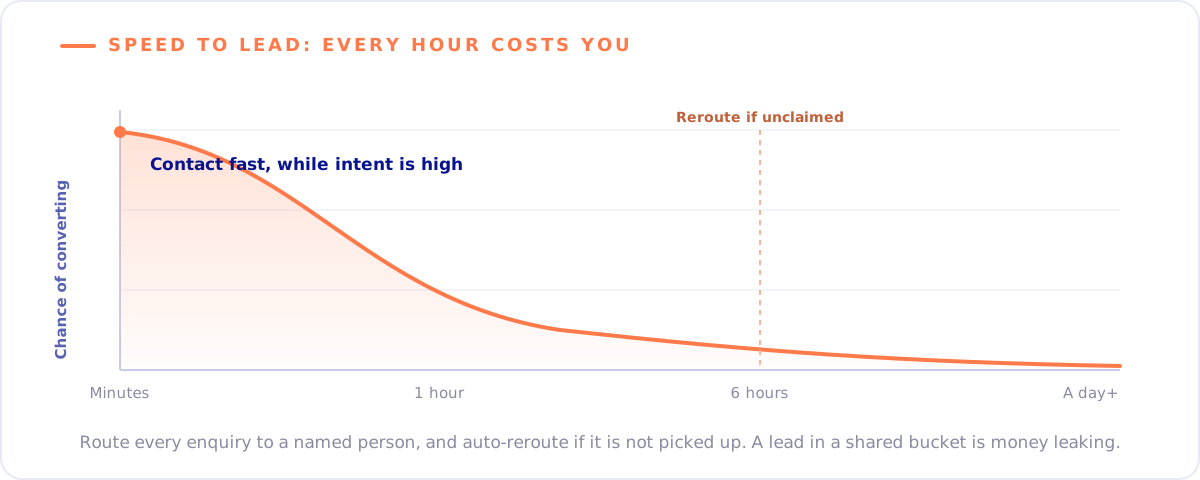
“The faster you get to that lead, the more chance you have of converting it,” Vera says. “The mistake organisations make is a lead comes in, gets put into a bucket, and this bucket sits there because it’s not sitting with an individual. No one’s told people to go and get things from the bucket.”
The fix isn’t always hiring more people. It’s routing. Every new enquiry should land directly in a named person’s queue, with an automatic reroute if it isn’t picked up within a defined window, Vera suggests six hours as a working model.
“Think about how much you spend on marketing to get these leads in. Every hour that lead sits there uncontacted, you’re losing money.”
For any clinic investing in healthcare SEO or paid search, this is a direct commercial issue. Traffic that reaches your site but never converts into a booked appointment is marketing spend with no return.
Which leads to prioritise, and how your form design decides that
One of the most practical insights Vera shared is how clinics can use their CRM to automatically surface high-value enquiries, but it starts much earlier than most people think. It starts with the form.
Most clinic contact forms ask for a name, an email address, and a free-text box. “What’s your message?” That unstructured data is almost impossible to act on at scale. Someone has to read every submission individually to work out what the person needs, how urgent it is, and who should follow up.
Vera’s solution is to replace the text box with structured fields that let the CRM do the prioritisation automatically. To illustrate the principle, she describes working with a car dealership: “When somebody hits their form, some dealers have 50 cars and 50 shops around the country. Some are a one-man band trying to sell a single car. When we looked at what makes a good lead, it came down to two fields: number of locations, and average cars per location. From that we could create a sophisticated prioritisation model.”
The clinical equivalent is straightforward. For a private clinic or dental practice, the fields that tend to separate high-value enquiries from low-value ones might include:
- What are you looking to be seen for? (dropdown of your core services – not a text box)
- How soon are you looking to be seen? (This week / Within a month / Just researching)
- Have you been seen privately before? (Yes / No)
- How did you hear about us? (for attribution)
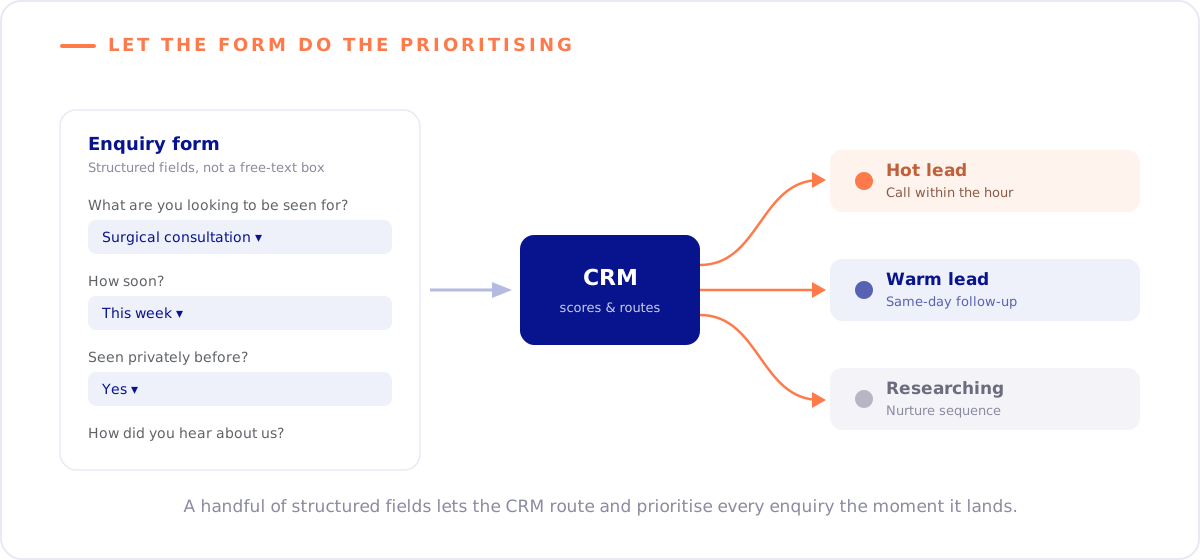
A patient selecting a surgical consultation, wanting to be seen within a week, and already familiar with private healthcare is a fundamentally different lead to someone who ticked “just researching” for a routine appointment. Your CRM should be routing and prioritising those two people differently from the moment the form is submitted, and it can only do that if the form is collecting structured data in the first place.
“It typically comes down to less than a handful of fields,” Vera says. “But you have to take a step back and ask: what does a good lead look like? And then work backwards from there.”
CRM vs practice management software: the distinction that matters
This is one of the most common points of confusion in clinic marketing, and getting it wrong creates real operational and data problems.
Vera’s definition is the clearest we’ve heard: “CRM is handling the relationship before that individual becomes a patient. Practice management software handles that relationship after they convert: patient information, clinical data, medical letters.”
In a well-designed clinic tech stack, CRM manages the top of the funnel. Once a patient books, the PMS takes over. The two systems need to talk to each other, but they shouldn’t be forced to do each other’s job.
We’ve covered this in detail in our piece on why your practice management software is a marketing decision. The short version: if your CRM and PMS aren’t integrated, your attribution will be broken and your marketing data unreliable.
Attribution: connecting marketing spend to actual patient revenue
This is where a well-configured CRM for clinics becomes a strategic asset, and where most practices are leaving serious insight on the table.
Patients rarely convert on first contact. They find you through a search, receive a couple of emails, forget about it, see a social post three months later, and then book. Which channel gets the credit?
Vera’s answer: all of them, proportionally. “Attribution is typically not a one-time activity. Conversion is usually the result of a series of touchpoints over months. Having an attribution model that looks at campaign influence rather than hard attribution gives you a much more realistic view of what’s actually working.”
That multi-touch picture is only possible if your CRM is recording every interaction, not just the final booking event. Connecting that data reliably to your marketing channels requires proper tracking infrastructure too. If you’re not sure whether your current setup is capturing the full picture, our GA4 and Google Tag Manager specialists can audit what’s being tracked and what’s being missed.
Why clinic CRM implementations fail

The most common reason a CRM implementation fails in a private clinic or dental practice isn’t the platform. It’s adoption.
Vera is direct about the root cause: “Training should be 80% why and 20% how. When people train new systems, it’s all about what to click, and very little about why they’re doing it. When staff understand how the data they’re entering impacts patient experience, reporting, and marketing decisions, they tend to be all in.”
The ownership question matters too. “It depends on the purpose. If the CRM is about converting leads, maybe marketing should own it. But it must have top-down support. Where CRM struggles is where a single department is trying to drive change that impacts others, without executive backing.”
For larger clinics and hospital groups, this governance question becomes even more important: the more people interacting with the system, the more critical it is that roles, permissions, and process ownership are designed deliberately from the start.
What the first 90 days should look like
Vera’s advice for the first 30 days is counterintuitive: don’t build anything yet.
“Take a massive step back. Evaluate what you want out of a CRM, the purpose behind collecting this data, what reporting you need at the end of it, and then work out what integrations that requires. Be conscious that it’s probably going to involve more than just the CRM platform itself.”
By 90 days, focus shifts to process: is the data clean, are staff using it consistently, and is there a mechanism to capture feedback and evolve the system as you learn?
The single metric to present to a clinic owner at 120 days? For most practices at an early stage, it’s conversion rate: the percentage of leads that become booked patients. “There has to be something concrete. Otherwise it’s too conceptual for people to know if it’s working.”
Ready to get more from your clinic’s CRM?
If this piece has raised questions about how your current setup is performing — or whether your enquiries, attribution, and patient journey are as joined up as they should be, our healthcare CRM and patient journey optimisation service is where to start.
We work with private clinics, dental practices, and larger healthcare organisations to design and optimise the full patient acquisition journey, from first click through to booked appointment and beyond. If you’re generating leads but not converting them at the rate you should be, that’s exactly the conversation we’re built for.
With thanks to Vera Loftis, founder of Solution Junkies, a specialist Salesforce consultancy working with healthcare organisations from independent practices to large hospital groups.