
Google Ads Compliance for Healthcare: The UK Playbook
Google Ads compliance for healthcare is where most campaigns are won or lost before a patient ever sees an advert. Healthcare is a restricted category on Google, which means stricter content rules than almost any other sector, and getting them wrong stalls your healthcare PPC management before it earns a single enquiry.
The good news is that it is a process, not luck. This guide sets out what Google’s healthcare advertising policy actually requires in the UK.
Why Google Treats Healthcare as a Restricted Category
Google groups healthcare with financial services and gambling because A misleading advert for trainers causes annoyance; a misleading advert for a cancer treatment causes patient harm and lasting damage to the platform.
So Google’s healthcare advertising policy is stricter than UK law, and on Google Ads the platform sets the bar. A policy breach does not mean you broke the law. It means you did not meet Google’s interpretation of risk, and that alone is enough to get an advert disapproved or an account suspended. The rest of this guide keeps you the right side of that line.

Who Needs Google Ads Healthcare Certification
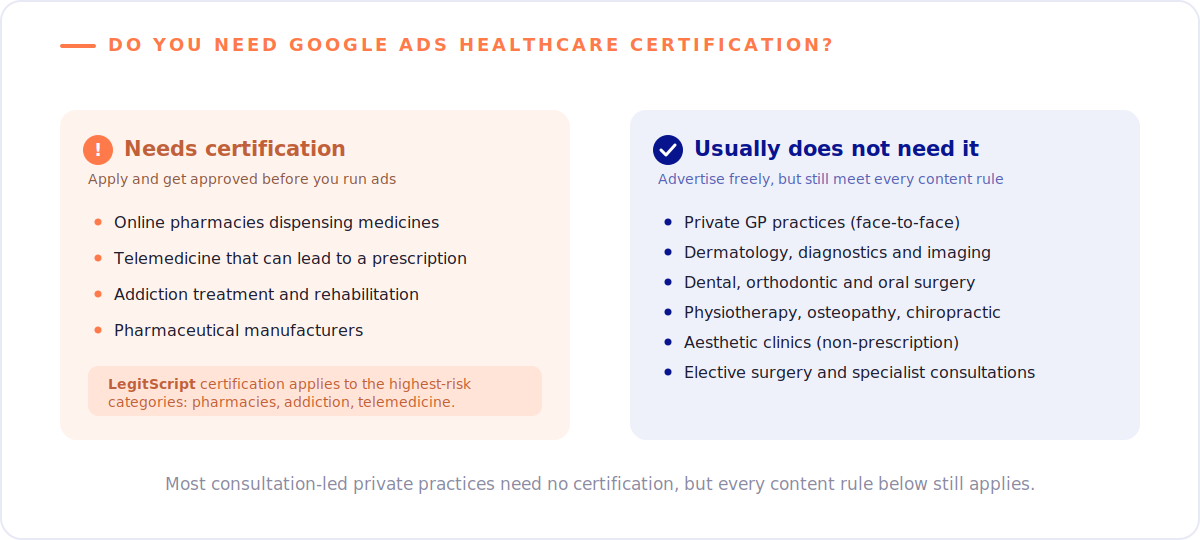
Not every healthcare advertiser must be certified by Google before running ads. Google Ads healthcare certification is category-specific. You apply for the certification that matches what you advertise, and most consultation-led private practices do not need one at all.
Prescription and Restricted Content
No naming a prescription-only medicine
Even fully certified, your advert cannot name a prescription-only medicine. Google’s UK policy lets you advertise the consultation that may lead to a prescription; the advert has to sell the service, not the drug. This most often trips up weight-loss, acne and hair-loss services.
No guaranteeing outcomes, implying a cure, or claiming the wrong approval
Google prohibits guarantees and risk-free claims, anything that presents an unproven treatment as a cure, and approval claims that do not apply in the UK.
| Rule | Disapproved | Compliant |
| Naming a medicine | “Get Ozempic for weight loss” | “Weight management consultation and prescription service” |
| Guarantees | “100% success rate” / “guaranteed pain relief” | “Clinically proven techniques; individual results vary” |
| Implied cure | “Cures diabetes naturally” | “Evidence-based diabetes management” |
| Permanence | “Permanent results” (for treatments that can recur) | “Long-lasting results; a review may be needed over time” |
| Approval | “FDA-approved” (in a UK advert) | “MHRA-approved” or “UKCA / CE marked” |
The fix for most of these is the same: swap the banned phrase for the condition, the service, or the evidence, and resubmit. Drug-name disapprovals are usually cleared within about a day.
No use of restricted imagery or promoting unapproved treatments
Two more draw disapprovals reliably. Before-and-after imagery is restricted across many cosmetic, aesthetic and surgical categories, so keep it off pages used as ad destinations. And speculative or unapproved treatments, off-label promotion to patients, or “alternative” therapies without peer-reviewed evidence are not allowed at all, however sound the clinical rationale feels.
Sometimes the ASA or GMC would allow something Google will not, such as a fair, evidenced comparative claim. The rule of thumb is that the most restrictive policy for the channel wins, and “it is legal in the UK” is not grounds for a Google appeal.
Compliant Healthcare Landing Pages
Google judges the advert and the page together, so a compliant advert pointing at a weak page is still held back: a mismatch lowers Quality Score, pushes up your cost per click, and can trigger a policy review. The page must also meet the same UK rules as the advert.
Pre-launch checklist
What a compliant healthcare landing page needs
- ✓ Regulatory detail: GPhC number for pharmacies, a link to your CQC report where applicable, GMC registration for doctors, and relevant memberships.
- ✓ Pricing, or a pricing statement: show fees, or say “pricing confirmed at consultation.” Do not hide cost behind a form.
- ✓ Privacy and UK GDPR: a privacy policy linked from every page, cookie consent, and how long you keep data.
- ✓ A suitability disclaimer: “a consultation is required to assess suitability, risks and alternatives,” with specific risk disclosure for surgery and high-risk procedures.
- ✓ Contact details and a real physical address: a virtual or mail-forwarding address can fail certification.
- ✓ Practitioner credentials: who delivers the care, and their qualifications and experience.
- ✓ Ad-to-page match: the page headline echoes the advert, and the advertised service is visible without hunting. Send treatment ads to a dedicated service page, not the homepage.
- ✓ Nothing prohibited: no prescription-only medicine names, no outcome guarantees, and no before-and-after images on an ad destination.
A practical tip: build one landing page per service you advertise. A single “treatments” page that an implants ad, a filler ad and a GP ad all point to will always underperform pages written for one intent.
Disapprovals and Suspensions at a Glance
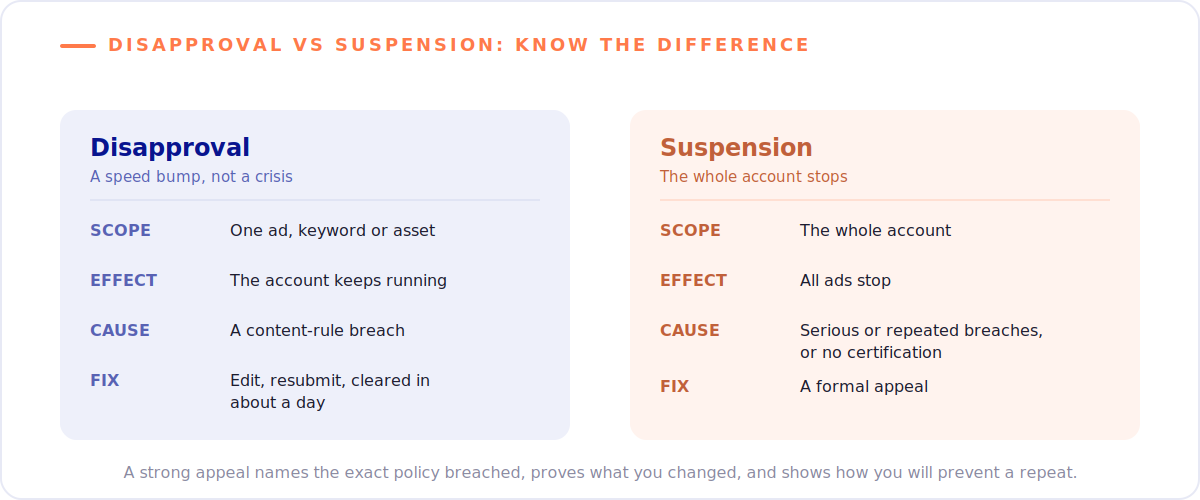
If you are suspended, a good appeal names the exact policy breached, shows what you changed with proof (updated pages, removed claims, certification obtained), and explains how you will prevent a repeat. Google reinstates only where the evidence is compelling, and repeat suspensions make it steadily harder, so make the first appeal count.
Where To Start
Certify only where your category requires it, write ads that sell the consultation rather than the medicine, keep claims within both Google’s and the ASA’s limits, and send every ad to a page that backs it up. Do that and disapprovals become rare and suspensions rarer still.
KD Web is a Google Partner with 25 years in healthcare marketing, handling certification, policy conflicts, and account recovery for clinics across diagnostics, aesthetics, private GP, fertility, orthopaedics and dental care. If you are launching a first campaign, recovering a suspended account, or caught between Google policy and UK regulation, book a free growth audit, and we will map your route to compliant, accountable growth.
Start your Google Ads campaign today.
This guide is accurate as of August 2026. Google changes its healthcare advertising policy regularly; confirm current requirements at support.google.com/adspolicy before launching a campaign.