
Healthcare SEO in the Age of AI: What’s Changing, What Isn’t, and What to Do Next
Every few years, someone declares SEO is dying. It never is. But right now, something genuinely is changing, and for doctors and healthcare practices, understanding what that means could be the difference between a full appointment book and an invisible online presence.
We sat down with Raymond Bucher, KD Web’s SEO Lead, to cut through the noise around AI search and what it actually means for healthcare practices in 2026. With over 15 years of SEO experience working across healthcare clients ranging from gynaecologists to ophthalmologists, Raymond has a habit of going deep on the why behind SEO trends rather than chasing them. His perspective on AI search is refreshingly direct: stop worrying about the wrong things, and focus on what’s actually moving patients through the door.

What is Actually Changing?
Traditional SEO worked on a simple chain: rank well, get visibility, get clicks, get traffic. AI search has interrupted that chain. Google and other search engines now surface AI-generated answers directly on the results page, answering queries before a user ever clicks through to a website. This is what the industry calls zero-click results, and they’re becoming increasingly common.
For healthcare, this stings in a particular way. Medical searches are frequently anxiety-driven. A patient notices a worrying symptom and types it into Google, looking for a quick answer to a complex, personal problem. AI is very good at providing that quick answer. The informational content that healthcare practices spent years building to capture searches exactly like these is now being bypassed at scale.
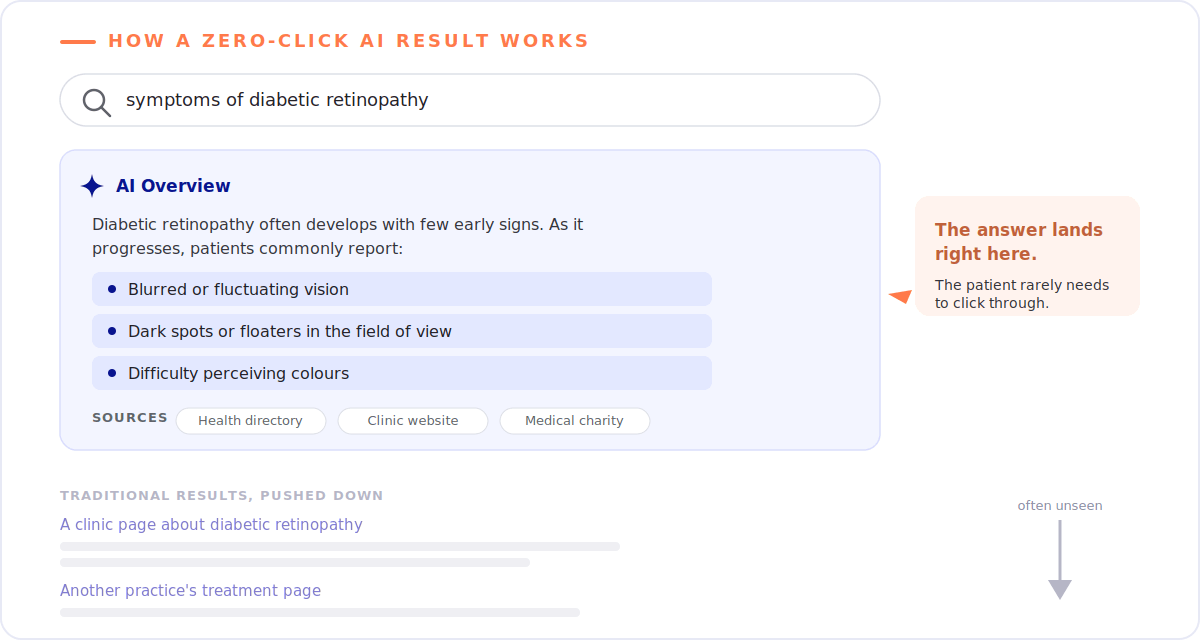
But Raymond is careful not to overstate the threat. “Usually when you don’t get a click, the search intent was only informational,” he explains. “If the user only wanted to gather information, they came to the site but didn’t really interact with it. They got the info and closed the tab.” The click existed, but it rarely converted into a patient anyway.
What’s more significant is the branding implication. When a patient saw your website in search results, even briefly, they saw your name and your credibility signals. The practices that will perform well in AI search are those that build genuine authority online through consistent mentions, named doctors, and consistent signalling with Local SEO across multiple online platforms.
Which brings Raymond to a point worth emphasising: good SEO and good AI visibility are not separate goals. “We have a lot of proof that ChatGPT, especially, is using Google and Google’s search results to get information and answers.” AI models are drawing from the same well as traditional search. If your content ranks well and your website demonstrates genuine expertise, AI will find it and reference it. The fundamentals haven’t changed; the surface they operate on has.
Are Specialists Measuring the Wrong Things When They Worry About AI?
The specific behaviour Raymond sees most often: a clinic owner opens ChatGPT, types in a query related to their speciality, and checks whether their practice appears in the answer. When it doesn’t, panic sets in. Raymond calls this exactly what it is: “a trap of a wrong vanity metric.”
It’s a form of confirmation bias. You search once, don’t appear, and conclude your SEO is failing. But AI models are inconsistent by design. Different models (ChatGPT, Gemini, Grok) pull from different sources, weigh information differently, and update constantly. There is currently no reliable, standardised way to measure AI visibility across platforms.
The marketing industry doesn’t have the right tools and data for that yet.
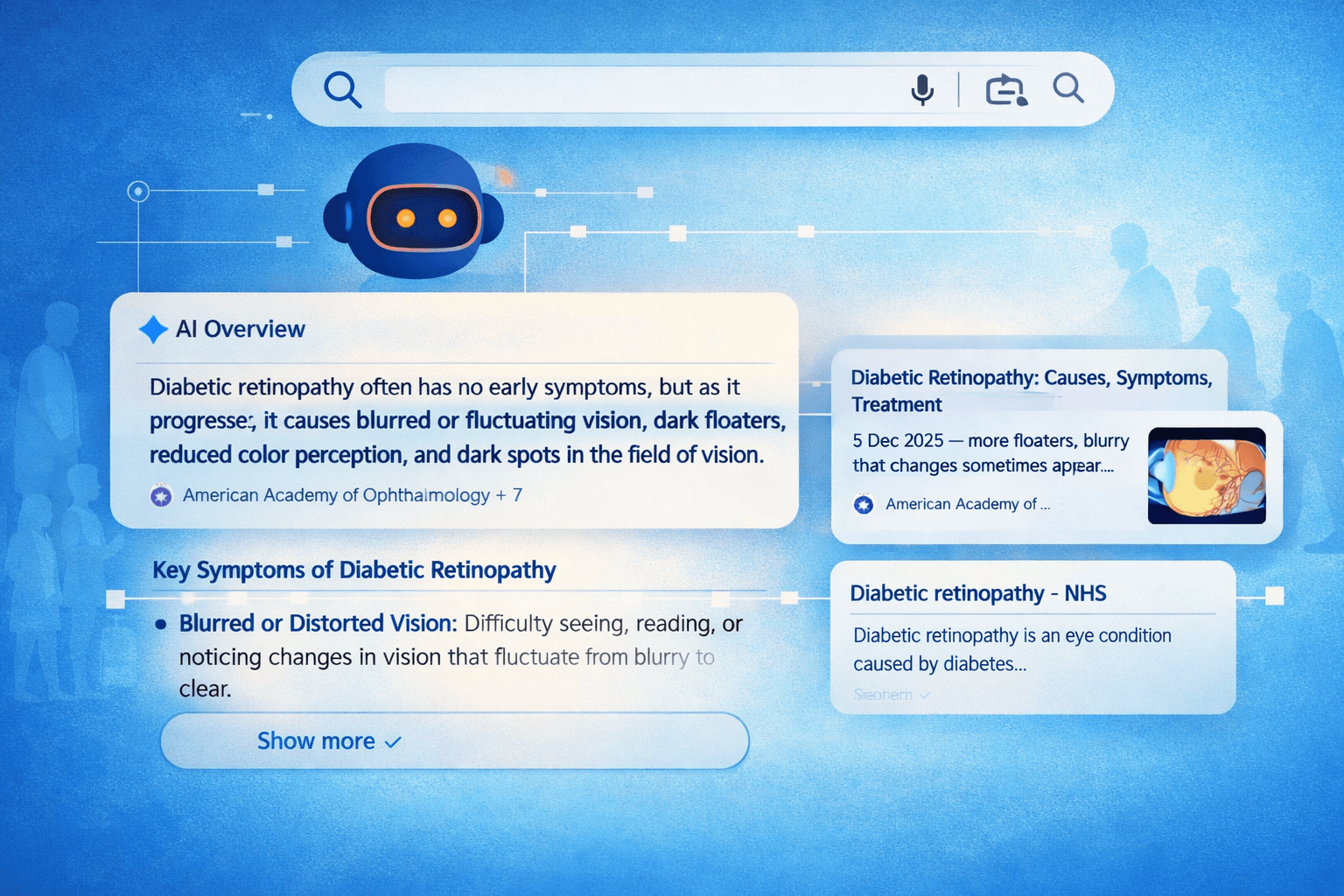
Loss of control over patient perception
Traditional search gave practices a degree of control. You could see what content was ranking, what patients were reading, and how they were forming impressions of your clinic before they made contact. AI removes much of that transparency.
When an AI model summarises your practice or answers a question about your speciality, you have limited visibility into what it’s saying or where it’s drawing from. Raymond points to a particular risk here: conflicting or inconsistent information online. “AI really likes to jump on that and make a pro-con overview.” If your website, directory listings, and social profiles contain inconsistent messaging about treatments, pricing, or processes, AI may amplify that ambiguity to the very patients you’re trying to attract.
“I don’t know how they’re finding me.”
This is the quiet frustration Raymond hears most often. The patient journey has become harder to trace. A patient might encounter your clinic’s name in an AI answer, search for you directly, find you through a directory, read a review, and then visit your website, all before making contact.
Each of those touchpoints influenced the decision, but only the final website visit shows up clearly in analytics. Practices are making decisions about where to invest in their marketing with an increasingly incomplete picture of how patients are actually arriving.
Where Do Patient Journeys Most Commonly Break Down?
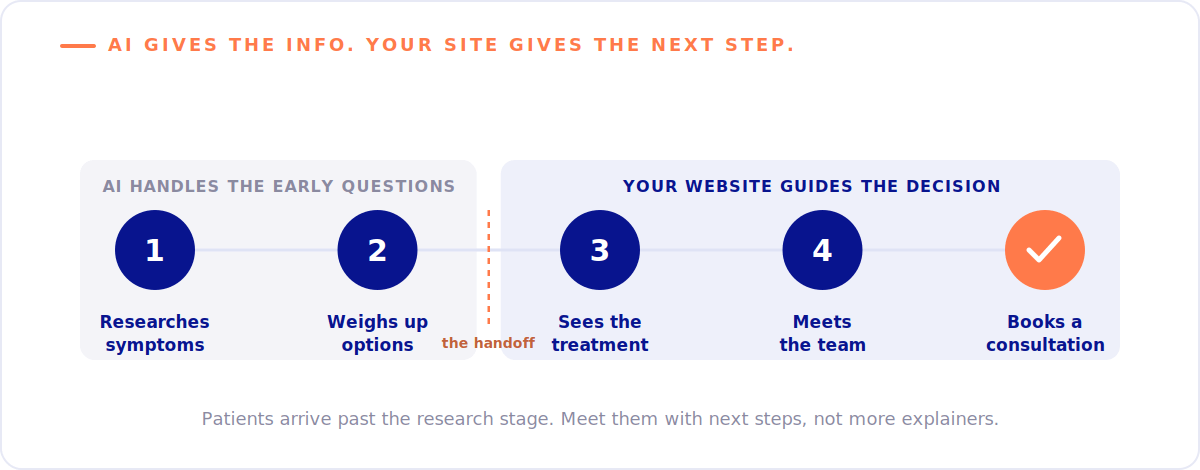
Getting a patient to your website is one problem. Getting them to book is another. Raymond identifies a widening gap as AI handles more of the information-gathering early stage: “There is a lot of educational content, but very few next steps.” Patients arrive at websites having already done much of their research through AI. They’re looking to be guided. And a website full of informational content without clear calls to action, logical page structure, or obvious next steps fails them at the critical moment.
AI can give all the info, but it’s still your job to give the next step.
This is something AI genuinely cannot replicate. A well-optimised website guides patients through a journey: from understanding a condition to learning about a treatment to meeting the team to booking a consultation. AI, by contrast, tends to keep users in a loop of queries and answers without ever nudging them toward a decision.
What Good Healthcare SEO Looks Like in the Age of AI
Raymond’s practical advice for 2026 is less about chasing AI and more about doing the foundational work that makes AI work for you.
1. Create content that serves mid and late-stage patients
The shift in patient journeys described above should directly inform your content strategy. If patients are arriving at your website already past the educational stage, build content that meets them where they are. Detailed process pages. Transparent pricing. Realistic expectations about treatments and recovery. Specialist profiles that feel like real introductions rather than CV summaries.
You need to show trust with doctors, real people, names, faces.
This is the content AI cannot generate on your behalf, because it’s specific to your practice, your team, and your patient experience.
2. Trust through clarity and consistency
When AI references your clinic in an answer, what does it say? You have more influence over that than most practices realise, but only if your online presence is consistent and up to date.
Your website, Google Business Profile, directory listings, and social profiles should all carry the same accurate information about your location, opening hours, contact details, and services. “Always keep your site up to date,” Raymond says. “Not even about the price, it’s about the address, the opening hours, anything like this.” Inconsistency doesn’t just confuse patients, but it gives AI models contradictory information to work with, and the results can actively undermine patient confidence in your practice.
3. Build authority through mentions
“The more places you are mentioned, the more likely AI will pick up on your clinic or profile.” Raymond points to this as one of the most underutilised levers in healthcare SEO. Traditional link building remains relevant, but brand mentions across authoritative, relevant sources are increasingly valuable in an AI-search world.
Being referenced on a medical conference website, cited in a professional directory, mentioned in a healthcare publication, or featured in a local news piece all contribute to the footprint that AI models draw from when forming answers. “Maybe from a conference, maybe from an academic paper, just a brand mention, it’s important because AI can get that and more easily refer back to you.” For named specialists in particular, building a presence beyond the clinic’s website through professional profiles, speaking engagements, and published commentary strengthens the signal that AI needs to confidently reference them.
Where to Start
The temptation when reading about AI search is to feel like everything needs to change immediately. Raymond’s advice is more measured: focus on what you can control, and do it well.
The practices that will navigate 2026 well are those that focus on what they can control: an accurate, current, well-structured website, a consistent presence across reputable sources, and content that serves patients who are ready to make a decision, not just those who are starting to ask questions.
Stop measuring AI visibility through vanity metrics you can’t yet trust. Start measuring what actually matters: calls, enquiries, and consultations booked. Those are the numbers that tell you whether your SEO is working.
“A good doctor cannot be a good marketer, and a good marketer cannot be a good doctor.” At KD Web, that’s exactly the division of responsibility we work towards. If you want to understand how your practice is positioned for search in 2026, we’re happy to take a look.