
Local SEO for Doctors and Specialists: A Complete Guide
You are an experienced specialist with excellent patient outcomes, but your appointment book isn’t as full as it should be. Meanwhile, a newer practice down the street seems to be attracting a steady stream of new patients.
To understand why this happens and what you can do about it, we sat down with Antónia Nagy-Abonyi, KD Web’s SEO Specialist. With years of experience working specifically with medical professionals, from dentists and dermatologists to gynaecologists and ophthalmologists, Antónia has seen firsthand what separates practices that thrive online from those that struggle to fill their schedule.
The challenge, as Antónia explains, starts with how patients search. When someone types “dermatologist near me” or “dentist in London” into Google, the search engine decides which practices to show based on local SEO signals. If your practice isn’t optimised for these searches, you’re essentially invisible to patients actively looking for your services, no matter how qualified you are.
Throughout this guide, we’ll share Antónia’s insights on the questions specialists often overlook, the misconceptions that cost practices patients, and the practical steps you can take to ensure your expertise translates into online visibility.

What is Local SEO?
Local SEO is the part of search engine optimisation that helps businesses and practices show up when people search for services near them. Think Google Maps, when people are searching for services “near me”, the results are what people are searching with explicit geographical intent. In short, it’s about being visible to the patients within your area who are ready to book.
Consider how your patients actually search. They are less likely to type “Dr Smith, award-winning dermatologist.” They are searching “dermatologist near me,” “emergency dentist London,” or “gynaecologist Harley Street.” These searches have clear intent: the person needs help, and they need it locally. Local SEO ensures your practice shows up in these high-intent moments.
The mechanics are straightforward: Google evaluates three main factors when deciding which practices to show:
- Relevance – Do you offer what they’re searching for?
- Distance – How close are you to the searcher?
- Prominence – How well-known and trusted is your practice online?
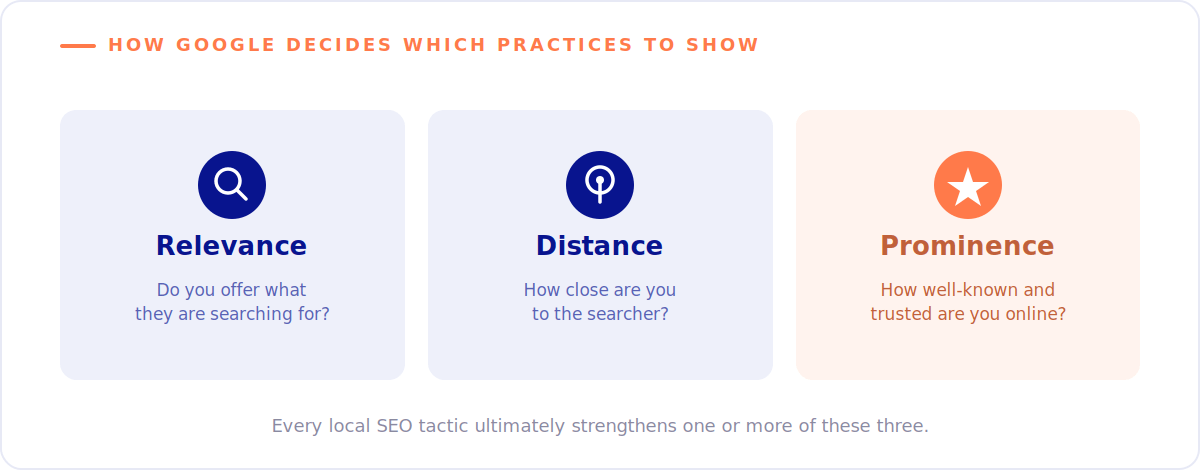
Every local SEO strategy ultimately addresses one or more of these factors.
Why Local SEO Matters for Doctors
Healthcare is inherently local. Your licence restricts where you can practise, and patients generally won’t travel hours for routine care. This geographic constraint makes local SEO not just helpful, but essential.
The majority of healthcare searches happen on mobile devices, often with “near me” intent. These searchers are almost always ready to book. If you’re not visible in those searches, you’ve lost the patient before they even know you exist.
In areas like Harley Street, dozens of specialists compete for the same patients. Two equally qualified dermatologists might be streets apart, but if one has strong local SEO and the other doesn’t, which practice do you think the patient finds first?
Patients searching for dentists, gynaecologists, or ophthalmologists are often anxious or in discomfort. They’re looking for signals that you’re legitimate, nearby, and available. Your Google Business Profile, complete with photos, reviews, and accurate information, provides that reassurance instantly. The threshold is higher than you might think: 37% of consumers won’t even consider a business with less than a four-star rating. A weak or absent local presence raises doubts before you’ve had any chance to demonstrate your expertise.
Practical Steps Specialists Can Take to Improve Their Local SEO
Antónia’s advice for doctors just starting with local SEO is simple: focus on two core areas first. You don’t need technical expertise to implement these steps, but they’ll make a real difference in your local visibility.
Claim and Optimise Your Google Business Profile
Your Google Business Profile is your practice’s storefront on Google Search and Maps.
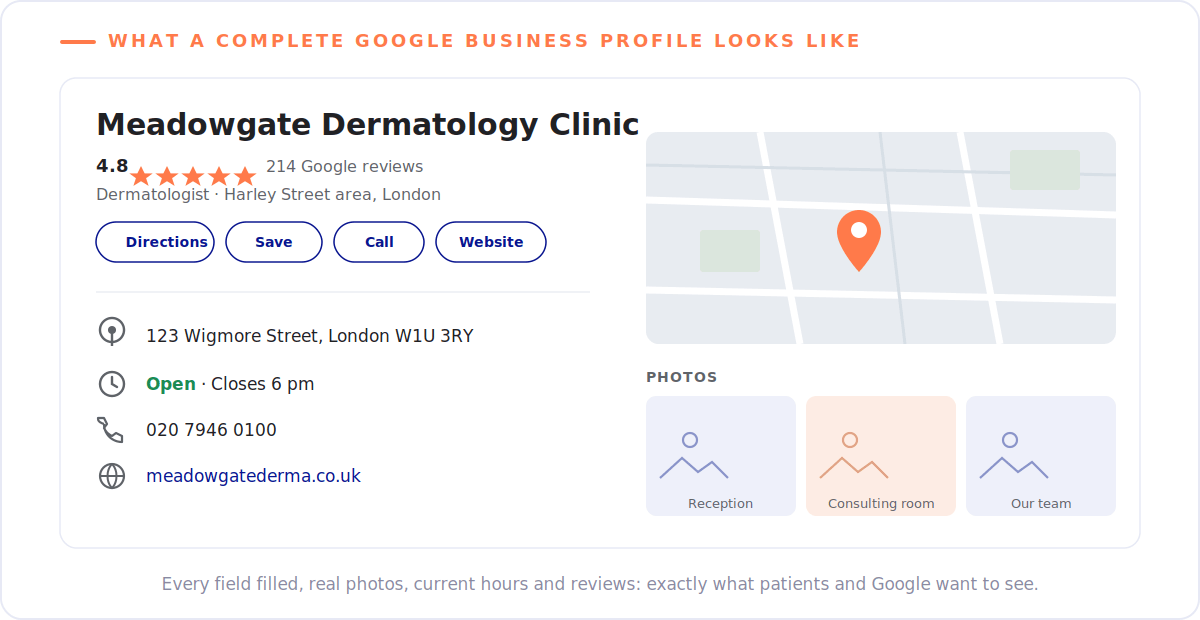
Here’s what many specialists miss: Google often creates these profiles automatically using publicly available data. Your practice might already have one, sitting unclaimed with outdated information or missing details. Search for your practice name on Google. If you see a profile in the knowledge panel (the box on the right side), claim it. If nothing appears, create one through Google Business Profile.
Once you’ve claimed it, fill every field: specialities, services offered, website link, phone number, and opening hours. Add photos of your actual clinic. Patients want to see the reception area they’ll walk into, the consultation rooms, and your team. These original photos signal authenticity to both Google and prospective patients.
Google Business Profiles have a posting feature, similar to social media. Post updates about new services, seasonal health tips, and changes to opening hours. Active profiles rank higher. Google interprets regular posting as a signal that your practice is operational and engaged, which pushes you up in local search results.
Keep your hours current. If you’re closed for Christmas or Bank Holidays, update your profile. Patients checking Google Maps for your hours and finding you “closed” when you’re actually open (or vice versa) damages trust and costs you appointments.
Maintain NAP Consistency
NAP (Name, Address, Phone Number) consistency sounds trivial, but it’s where many practices lose rankings without realising it.
Google cross-references your practice information across hundreds of sources: your website, Google Business Profile, social media, healthcare directories, and review sites. When it finds inconsistencies, it loses confidence in which information is correct. Is your practice at “123 High Street” or “123 High St”? Is the phone number (020) 1234 5678 or 020-1234-5678? These variations might seem inconsequential, but they fragment your local SEO authority.
Start with your online profiles audit. Write down your practice name, full address, and phone number exactly as they should appear everywhere. Then systematically check and update each platform. This work might look tedious, but this consistency is foundational. Without it, other local SEO efforts have a limited impact.
What’s the One Biggest Thing Doctors Are Forgetting That’s Hurting Their Local SEO?
Antónia says: reviews. Specifically, not having a system to manage them. “Many specialists see reviews as something passive,” Antónia explains, “but in local SEO they’re one of the strongest trust signals.” The problem isn’t that doctors don’t understand reviews matter, it’s that they wait for patients to leave feedback organically, which rarely happens. Satisfied patients leave the appointment and get on with their lives. Dissatisfied patients, on the other hand, are highly motivated to share their experience.
Here’s what Antónia recommends: build review requests into your patient journey. After a successful appointment, send a follow-up message thanking them for their visit and including a direct link to your Google Business Profile review page. Make it effortless. Most patients are happy to leave positive feedback when asked; they simply don’t think to do so on their own.
Now, the part many specialists avoid: responding to reviews, especially negative ones. “What I always emphasise,” says Antónia, “is that it’s not about having only five-star reviews because Google does not expect perfection from any of the businesses online.” What matters far more is engagement. Do you respond professionally? Do you address concerns? This signals credibility to both the algorithm and prospective patients.
If you ignore reviews, especially the critical ones, it can quietly undermine local visibility.
When DIY Local SEO Isn’t Enough
The strategies above (Google Business Profile, NAP consistency, reviews) are foundational. They’ll improve your visibility. But if you’re in a competitive market or want to dominate local search results, you need a more comprehensive approach.
This is where strategic local SEO becomes less about maintenance and more about competitive advantage. At KD Web, we work with specialists who’ve hit the ceiling of what they can achieve on their own. Here’s where we focus:
Mobile Experience (Not Just Mobile-Friendly)
Most healthcare searches happen on mobile, and you are probably aware of this. What you might not know is that Google evaluates your site’s mobile experience more harshly for local searches than for general searches. Page load speed, tap target sizes, readability without zooming, these are strong ranking factors. A slow website eliminates you from consideration before patients even see your content. We’ve seen practices gain significant ranking improvements simply by optimising load times and simplifying mobile navigation. The patients searching “dentist near me” while in discomfort aren’t patient with slow websites. They’ll click back and choose your competitor.
Strategic Local Backlinks
Backlinks (other websites linking to yours) remain one of Google’s core ranking factors. For local SEO, where those links come from matters enormously. A link from a local health directory, a nearby hospital’s resource page, or a community organisation carries more local SEO weight than a link from a national website. Building these links requires relationships and strategic outreach. We focus on getting practices featured in local publications, healthcare directories specific to their speciality, and partnerships with complementary local services. It’s not fast work, but it compounds. Each quality local backlink strengthens your geographic relevance in Google’s eyes.
Localised Content
Many practice websites have generic service pages that could apply to any specialist anywhere. “We offer dermatology consultations”, tells Google nothing about your location or the specific community you serve. Localised content explicitly mentions your area, references local landmarks or neighbourhoods, and addresses concerns specific to your patient population. For instance, a dermatologist in London might create content about “Managing Eczema in London’s Hard Water Areas” or “Skin Cancer Screening Near Harley Street.” These pages rank for location-specific searches and demonstrate local expertise.
Instead of generic health advice, we create content that answers questions your local patients actually ask. It positions you as the local authority, which is precisely what Google’s local algorithm rewards.
Service Pages That Convert Searchers into Patients
Your service pages have two jobs: rank in search results and convert visitors into booked appointments. Most practices optimise for one but not both. Effective service pages clearly state what treatment you offer, who it’s for, what patients can expect, and how to book. They naturally include local keywords, address common concerns, and remove friction from the booking process. Every element serves a purpose: build trust, answer questions, and make taking the next step obvious.
Supporting blog content plays a different role. Blogs attract patients earlier in their research phase, building familiarity and trust. When someone later searches for your specific service, they’re more likely to recognise and choose your practice. This is the compound effect of content done right: each piece supports the others.
Common Local SEO Misconceptions That Cost Doctors Patients
When we asked Antónia what mistakes she sees most often, she didn’t hesitate: “These misconceptions cost doctors their patients every day.” Here are the myths that hold medical practices back.
Local SEO is a one-time setup
This is the most expensive misconception. Specialists set up their Google Business Profile, optimise their website once, then wonder why rankings decline six months later. Local SEO is ongoing because the landscape never stops moving. You don’t need to work on local SEO daily, but quarterly audits and regular profile updates are non-negotiable for maintaining visibility.
I don’t have time for social media, so I’ll skip it entirely
You don’t need to post daily or build a massive following. But having claimed profiles on relevant platforms with consistent NAP information strengthens your local presence. These profiles often rank in search results for your practice name, giving you control over the information patients see. An abandoned social profile is worse than no profile. If you claim a Facebook page or Instagram account, commit to minimal maintenance: accurate information, occasional updates, and responses to messages. Even quarterly posting is better than creating profiles and forgetting them.
Where to Start
Local SEO for medical practices isn’t complicated, but it is comprehensive. The fundamentals (Google Business Profile, NAP consistency, review generation) you can handle yourself. They’ll deliver measurable improvements if you commit to maintaining them. Where practices typically need support is scaling beyond the basics. Competitive markets demand more than fundamentals. If you’re in an area with established specialists or you’re trying to attract patients from a wider geographic area, strategic local SEO becomes essential. The question to ask yourself: are you losing patients to competitors because they’re better clinicians, or because they’re more visible online? If it’s the latter, that’s a solvable problem.
At KD Web, we work exclusively with healthcare practices to build local SEO strategies that align with how patients actually search for care. If you’re ready to compete on visibility, not just clinical expertise, let’s discuss how we can help.