
Why Most UK Medical Brands Look Identical (And How to Fix It)
Choosing a medical provider is not a simple transaction for a patient. It’s personal and high-stakes. Patients are placing their health, or their family’s, in someone’s hands, and they need a reason to trust you specifically.
That reason is your brand. Strong branding answers the question every patient asks before they book: why should I trust you with my health?
This guide covers what medical branding is, the UK rules that shape it, and what strong branding looks like in practice.

What Is Medical Branding?
Medical branding is the full experience a patient has with a provider: visual identity, messaging, tone, digital presence, communication, reputation, and the clinic itself. It is the impression built across every touchpoint, from the first search result to the follow-up appointment.
Good branding answers four questions before a patient books:
- Who are you for? The patients you serve best.
- What do you do differently? Your clinical approach or specialism.
- Why should I trust you? Credentials, transparency, consistency, empathy.
- What will my experience be like? The journey, the communication, the access.
Each answer must be grounded in clinical reality, not marketing language.
Medical Branding vs Healthcare Branding
The two are often treated as the same, but in practice they’re far different.
Healthcare branding covers hospitals, insurers, pharmaceutical companies, device manufacturers, and pharmacies. The relationship is institutional or B2B, and the focus is corporate identity and large-scale reputation.
Medical branding is narrower. It covers GP practices, consultants, surgeons, dentists, aesthetic practitioners, and specialist clinics. The decision usually centres on one practitioner or a small team, and the patient relationship is longer and more personal.
The difference changes the branding intent. Medical branding has to show personal trustworthiness, clinical competence, and empathy at a human scale, not corporate authority.
Why Medical Branding Matters
Patients are assessing whether they feel safe placing their health in your hands. That judgement comes from consistency, professionalism, clarity, and empathy, which are all branding concerns.
Strong branding builds trust in practical ways:
- Consistency across your website, clinic, and communications signals reliability.
- Clear messaging respects a patient’s time and attention.
- Professional design and tone suggest matching clinical standards.
- Empathetic language and imagery show you understand patient concerns.
Healthcare is a high-trust sector, but that trust belongs to the profession, not automatically to you.
Standing Out in a Crowded Market
Private GPs, aesthetic practitioners, and consultants often offer similar services. Patients comparing them cannot judge clinical quality directly, as they lack the expertise. What they can judge is how each practice makes them feel: understood and reassured, or uncertain and interchangeable.
Branding is what separates a practice that feels like a commodity from one that feels like the right choice. It directly affects patient numbers, retention, and referrals.
This matters more each year. UK private healthcare admissions hit record highs in 2025 for the fourth year running, and the number of consultants practising privately reached a record of nearly 13,400. More providers competing for the same patients makes differentiation essential, not optional.
Being Found in Search
Google handles more than a billion health-related searches a day. Patients decide whether a practice looks trustworthy in seconds, long before they book.
A strong brand helps at each stage:
- Search visibility: as awareness grows, more people search for you by name, and a clear brand supported by an SEO agency can improve click-through rates from organic search results and paid listings.
- Website conversion: a consistent brand reduces doubt, so more visitors enquire or book.
- Reputation: a cohesive brand encourages the positive reviews and referrals that bring in more patients.
A weak brand sends patients elsewhere, even when the clinical outcomes are excellent, because they cannot assess clinical quality in advance. They judge the brand instead.
The Rules That Shape Medical Branding in the UK
This is where UK practices differ from most branding advice, which is written for the US or general consumer market.
Medical branding in the UK works under strict rules. Practices answer to the General Medical Council (GMC), the Care Quality Commission (CQC), and the Advertising Standards Authority (ASA), which enforces the CAP Code. These set what you can say:
No guarantees or exaggerated claims: You cannot promise outcomes or overstate results. Claims must be evidence-based.
- Careful use of testimonials: Reviews must be genuine and representative. You cannot select only positive ones or pay for feedback.
- Limited comparison: Claims of being “the best” or better than named competitors need strong evidence and cannot denigrate others.
- Professional tone: Sensationalism, scare tactics, and trivialising health all breach the rules.
Faced with these limits, most practices default to the safest language, “trusted,” “caring,” “patient-centred,” and end up sounding like everyone else.
The answer is specificity, not bolder claims. You cannot call yourself “the best knee surgeon in London.” You can say you treat only sports knee injuries, publish your own audited outcomes, and offer a 48-hour scan-to-diagnosis pathway. All three are verifiable, compliant, and far more distinctive than a superlative.
Strategy Comes Before Design
Effective branding starts with strategy, and these 4 questions come first:
| Question | What to pin down | Example |
| Who are we for? | Your ideal patient: age, health concerns, values, and motivations | A practice serving young families needs a different brand from one serving executives or older patients with chronic conditions |
| What do we do differently? | Your clinical approach, named specifically | Holistic or interventionist; prevention or treatment; specialist depth or general breadth |
| What must patients believe to choose us? | Your single most important trust signal | Credentials, access, communication, technology, or outcomes |
| What is our brand personality? | How patients should feel during and after their visit | Reassured, informed, cared for, respected |
These answers shape everything else: visual identity, website structure, communication templates, and reception training.
Map the Patient Journey
A medical brand is experienced across many different touchpoints. Consistency at every stage creates a more cohesive experience, optimising the patient journey from start to finish.
- Awareness: how patients find you (search, referral, advertising).
- Research: what they see when checking you out (website, reviews, credentials).
- First contact: booking or enquiring (phone manner, email response, ease of booking).
- Pre-appointment: how they are prepared (confirmation, directions, what to expect).
- Appointment: the in-person experience (clinic, staff, clinician communication).
- Post-appointment: follow-up and retention (results, next steps, satisfaction checks).
- Advocacy: what makes them return and refer (outcomes, relationship, consistency).
The brand promise has to hold at every stage, not just on the homepage.
Design That Earns Trust
Design comes last, but it carries the first impression. Once the strategy is set, the visual identity is what a patient actually sees, and it has seconds to signal competence and care before they read a word. Three elements do most of that work: the logo, the typography, and the colour.
Logos and visual identity
A medical logo has one job: look credible and distinct at a glance, at any size. The strongest are simple, legible, and matched to who the practice serves: warm for a family practice, precise for a surgical consultant.
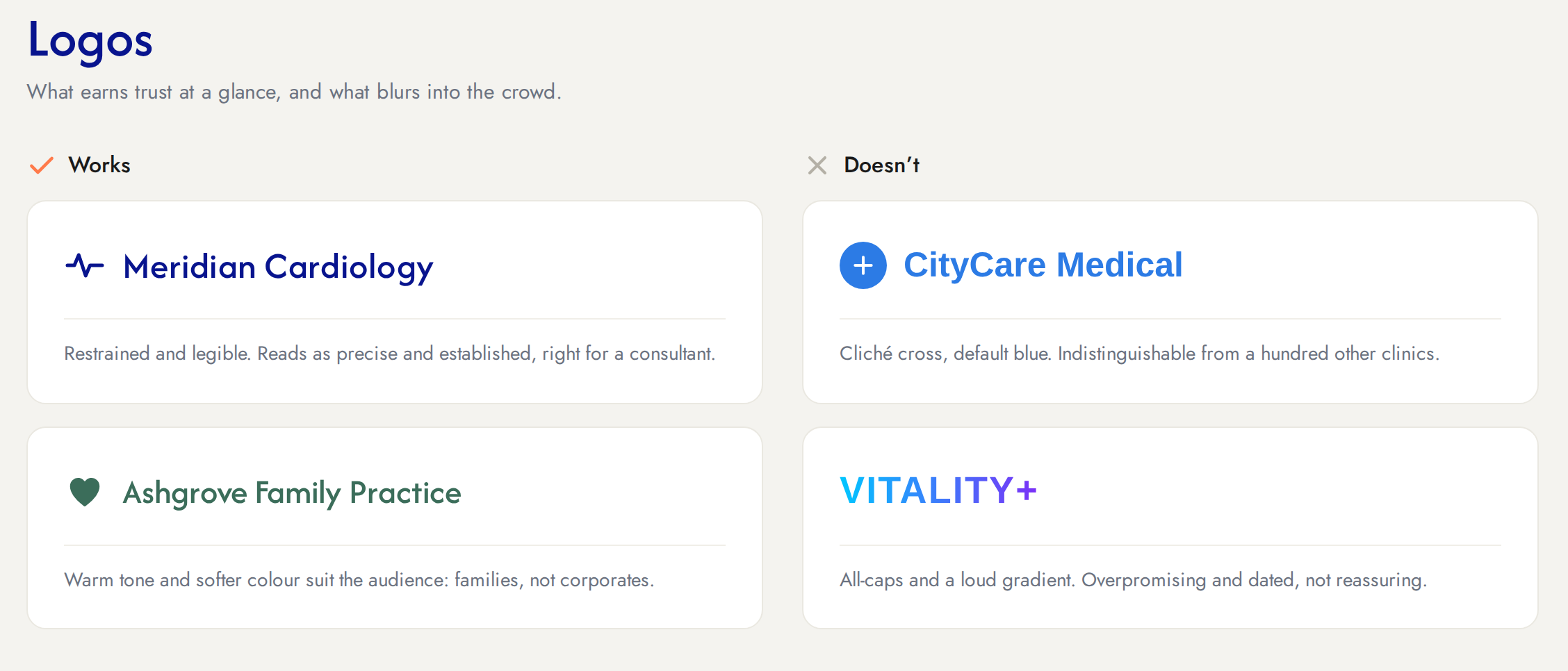
What works is restraint, legibility, and a tone that fits the audience. What doesn’t is generic medical clip-art, loud gradients, and all-caps names that shout instead of reassure.
Typography
Clear hierarchy: a headline, a supporting line, readable body text, tells a patient you respect their time. A calm, well-set page feels like a calm, well-run practice. Two well-paired typefaces are plenty: one with character for headings, one clean and highly legible for everything else.
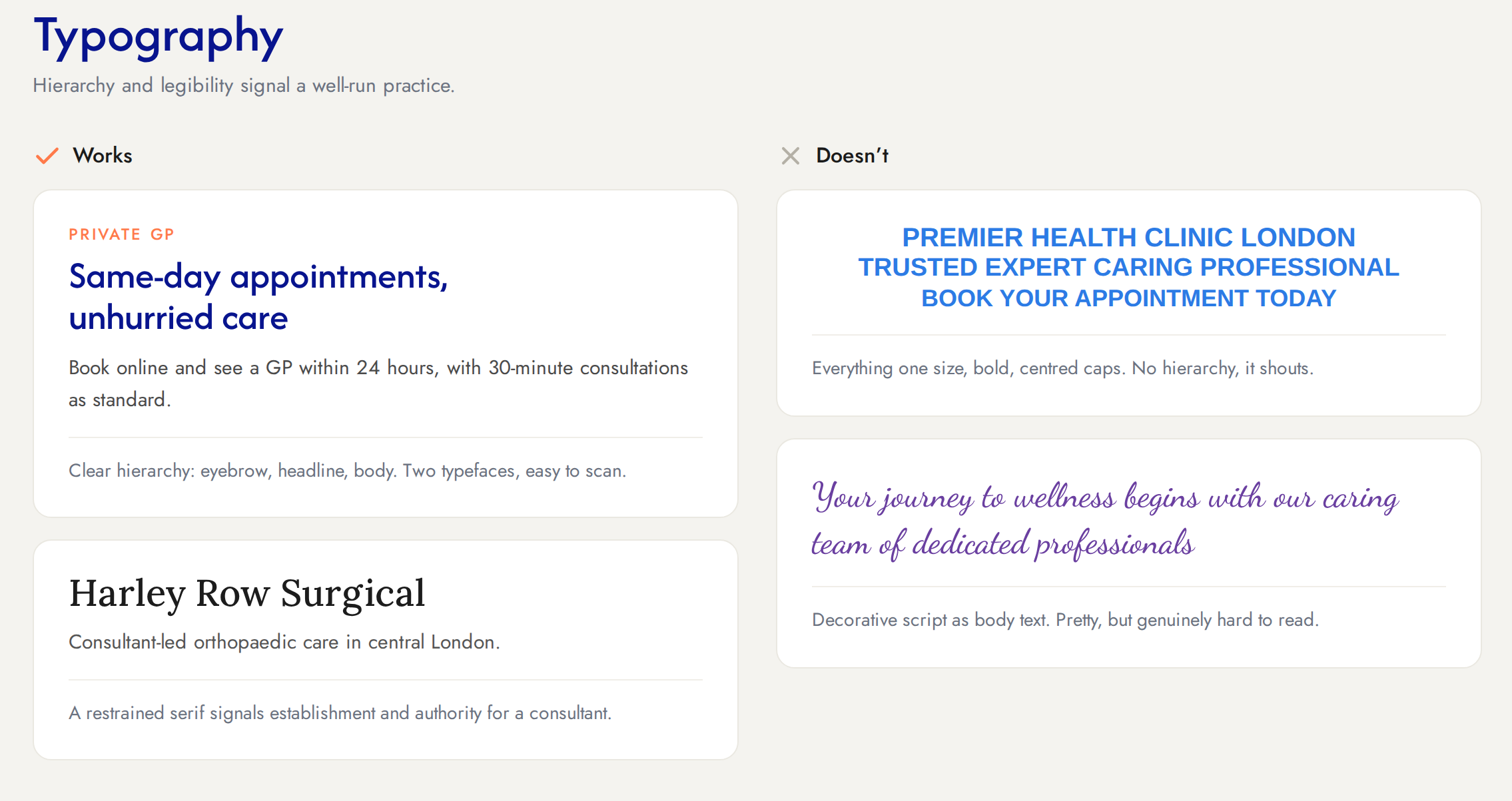
What works is obvious hierarchy, generous spacing, and no more than two typefaces. What doesn’t is everything set at one size, or a display face used at a size it can’t be read at.
Colour
Colour is the fastest way to look like everyone else or to stand apart. In medical marketing, you have far more room to differentiate on colour than most practices use.
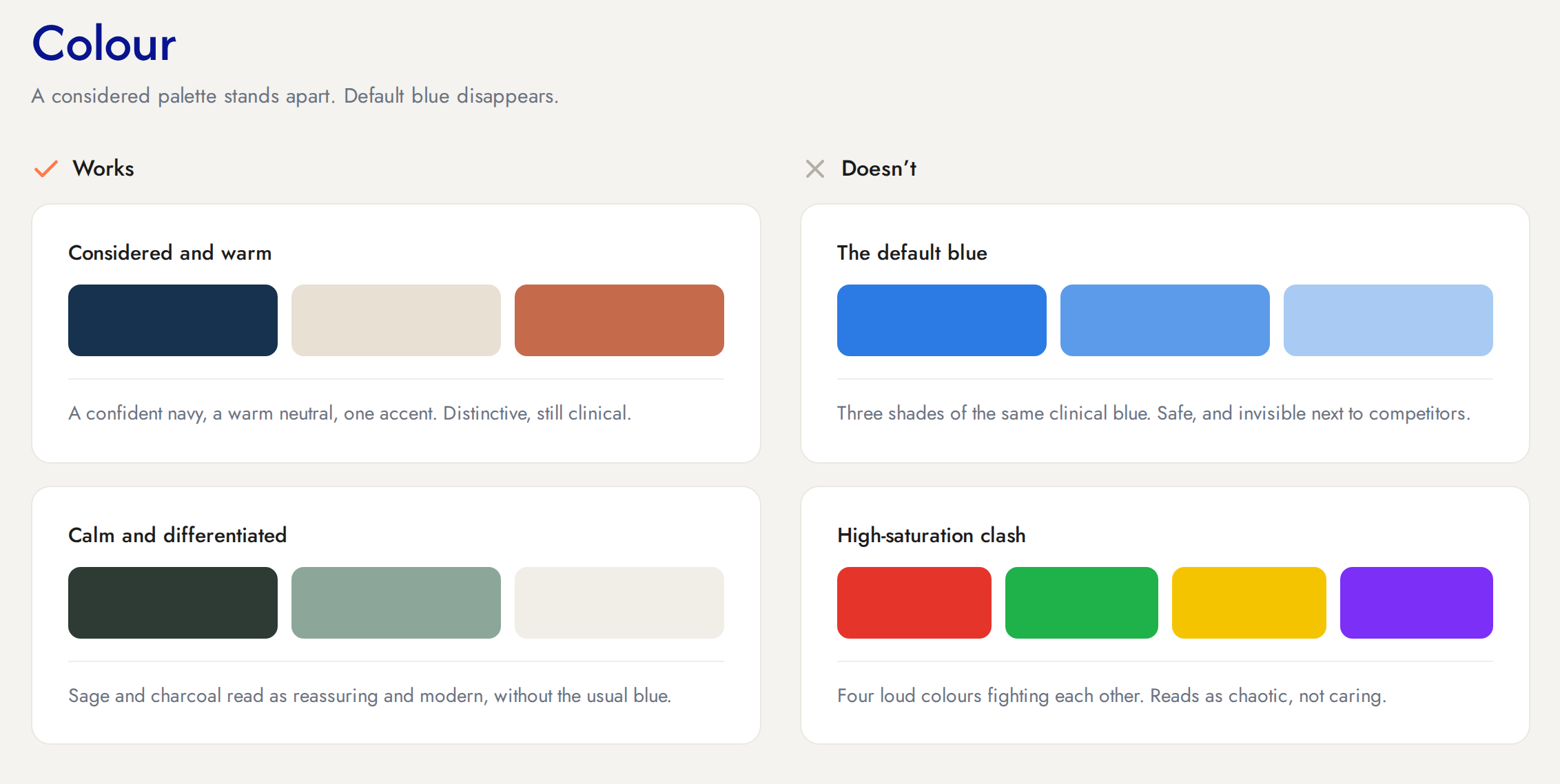
What works is a restrained palette with one clear accent, chosen to fit the practice rather than the sector. What doesn’t is defaulting to the same clinical blue as every competitor, or a high-saturation clash that reads as chaotic rather than caring.
How to Measure Branding Performance
Branding feels intangible, but the results are measurable. Track these over time:
- Patient acquisition: new enquiries, bookings, and referrals by source (organic, paid, word-of-mouth). Growth signals rising awareness.
- Retention: repeat appointments and treatment completion. Strong branding improves loyalty and lifetime value (what a patient is worth over the whole relationship).
- Search visibility: how many people search for your practice by name. This is a direct measure of brand awareness.
- Conversion rate: the share of website visitors who enquire or book. A trustworthy brand improves it.
- Reputation: review volume and sentiment, testimonial requests, referrals.
Branding takes time. Unlike PPC, it does not deliver instant leads. But over months and years, it lowers the cost of acquiring each patient, raises lifetime value, and builds an advantage competitors cannot easily copy. Practices with strong brands compete less on price and hold up better when the market tightens.
Set benchmarks before you rebrand and track them consistently. Expect real movement within six to twelve months, and compounding gains after that.
The Bottom Line
Medical branding is an investment in trust, differentiation, and long-term growth. Where clinical services look the same, branding is the deciding factor.
If your practice looks like every other practice, you are competing on location and price alone. That is a race to the bottom.
Strong branding competes on clarity and trust instead. If you want a view on where your brand stands today, that is the kind of work we do.