
PPC for Dentists: How to Make Google Ads Work for Your Practice
Pay-per-click advertising puts your practice at the top of Google. For a newer dental clinic, PPC looks like the fastest route to patient flow. It can be, but only when the right infrastructure sits beneath it.
This guide explains how PPC for dentists actually works: what it delivers when run properly, how campaigns are structured around dental service lines, and what you need in place before the first ad goes live.
What PPC Actually Delivers for Dental Practices
When someone searches “emergency dentist Finchley” or “dental implants North London”, your ad can appear within hours of launch.
You can turn PPC on and off with capacity, test messaging for new treatments, and target areas precisely. Its advantage over other marketing channels is speed and attribution: every click, call, and booking traces back to a specific keyword, ad, and campaign.
PPC buys visibility, not patients. The top paid positions capture a large share of the clicks, but a click becomes a patient only when keyword, ad, landing page, offer, and front-desk handling all line up. A poorly built campaign produces hundreds of clicks and no bookings because it runs as a traffic channel rather than a patient-acquisition system.
Campaigns built around specific treatments, ads matched to dedicated pages, enquiries tracked to revenue, and decisions made on cost per patient acquired, not cost per click.
Structuring Dental PPC Around Treatments
Effective PPC advertising for dentists is organised by service line. Build separate campaigns for emergency dentistry, implants, Invisalign, teeth whitening, and routine care, because each attracts different search intent and justifies a different cost per acquisition.
- Emergency dentistry targets high-urgency queries such as “emergency dentist open Saturday” or “broken tooth repair near me”. These convert quickly but often carry lower lifetime value. Focus the budget on local visibility and immediate-availability messaging.
- Implants and cosmetic treatments justify a higher cost per click because the lifetime value is substantial. Searches like “dental implant cost London” or “Invisalign provider Hampstead” show research intent: the person is comparing options and assessing expertise, so the landing page must answer cost questions openly, prove credentials, and provide a clear route to book.
- Routine and preventative care (check-ups, hygiene, fillings) draws broader, lower-intent traffic. Competing on “dentist near me” is expensive and often unprofitable unless you have the capacity to turn those enquiries into long-term patients.
Each service line needs its own keywords, ad copy, and landing page, and the implant ad must land on the implant page. That relevance lowers your cost per click and lifts conversion at the same time.
If you are new to PPC or even healthcare marketing, start with one or two high-value lines where you have capacity and the pages to convert, then scale once the foundation proves profitable.
Keyword Intent in Dental Search
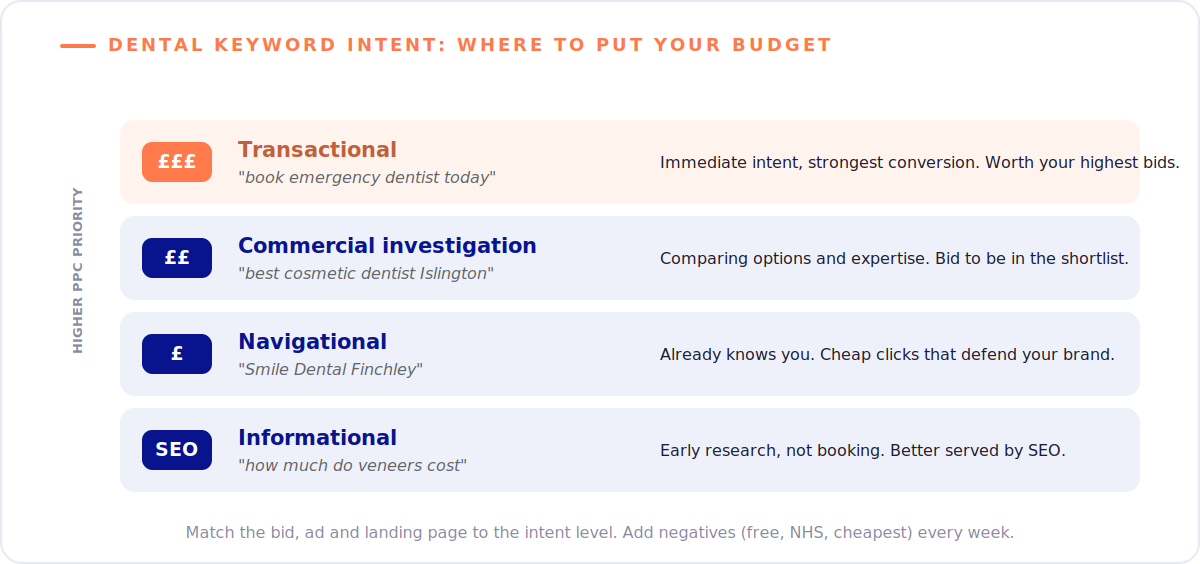
Not every dental keyword signals the same readiness to book, and your bids and pages should track that.
| Search Intent | Example Queries | What It Signals |
| Navigational | “Smile Dental Finchley” | The patient already knows you and wants your details |
| Informational | “how much do veneers cost”, “are implants painful” | Early research, not booking |
| Commercial investigation | “best cosmetic dentist Islington”, “implant reviews London” | Comparison behaviour |
| Transactional | “book emergency dentist today”, “implant consultation near me” | Immediate intent, strongest conversion, worth the highest bids |
The discipline is matching bid, ad, and page to the intent level.
Negatives matter too: if you are private, exclude “free”, “NHS”, “cheapest”, and “student discount”, and add “DIY” and “home remedy” to filter out self-treatment searches. Review the search-term report weekly and keep adding exclusions.
Matching Ads to Landing Pages
Every ad needs a page that confirms within two seconds that the visitor is in the right place, with a headline that echoes the ad.
Landing page checklist
What an effective dental landing page needs
- ✓ A headline and subheadline that mirror the ad and the search, confirming within two seconds the visitor is in the right place.
- ✓ The treatment explained in plain language, what it involves, how long it takes, what to expect. Write for the anxious patient, not the clinical peer.
- ✓ Transparent or starting-from pricing. Cost is the first question. Hiding it sends people to call (many will not) or leave (most will).
- ✓ Dental trust signals: GDC registration, relevant memberships, reviews, and before-and-after galleries where appropriate.
- ✓ A clear call to action repeated down the page, with click-to-call on mobile, since most dental searches happen on a phone.
- ✓ Fast load and mobile layout. A page that is slow or needs pinch-and-zoom loses the booking.
If you cannot support many pages yet, run PPC only on the one or two services that already have strong dedicated pages.
GDC and ASA Compliance for Dental Ads
PPC for dentists in the UK sits under General Dental Council (GDC) guidance and the ASA’s CAP Code. Breaching them risks regulatory action, Google disapprovals, and reputational harm. The dental specifics:
No misleading or unverifiable claims. Avoid “pain-free guaranteed”, “best dentist in London”, or “permanent solution”. Be specific and evidence-based instead, and only cite figures such as implant survival rates if you can stand them up.
- Transparent, complete pricing. “Implants from £2,400” is fine if it is a genuine starting price. “£995 implants” is misleading if it excludes surgery, crown, or consultation.
- Clear credentials. Show your GDC registration number, and hold the right postgraduate qualifications for any specialist treatment you advertise.
- No pressure tactics. “Only 3 slots left this week” and countdown discounts have drawn ASA rulings in healthcare.
- Responsible imagery. Before-and-after photos must be your own work, show realistic outcomes, and carry a variation disclaimer.
- No targeting children. Aim orthodontic and children’s dentistry messaging at the parent.
Those are the dental-specific rules. The wider framework behind them- Google’s healthcare certification categories, prescription and content restrictions, and how to handle a disapproval or an account suspension- is covered in our guide to Google Ads compliance for healthcare.
What Drives Cost in Dental PPC
Cost per click varies with competition, location, intent, and how well the campaign is built.
| Cost driver | Why it moves the price | What to do about it |
| Service line | Implants, veneers, and Invisalign cost more per click because rivals will pay more for those patients; routine care costs less but is worth less. | Bid up only where lifetime value justifies it, not evenly across every treatment. |
| Location | Central London and other big cities cost more than smaller towns, and the more local practices bidding on “dentist near me”, the higher the price. | Expect higher CPCs in saturated areas; a tight radius keeps spend on reachable patients. |
| Keyword specificity | Broad terms like “dentist” cost more and convert worse than long-tail, explicit ones like “same-day emergency dentist Finchley”. | Favour explicit, long-tail keywords: cheaper clicks and clearer intent. |
| Quality Score | Relevant, fast, treatment-specific pages cost less per click than generic ones. | Send each ad to a dedicated, fast page to lower cost and improve position. |
As a rough guide, UK dental clicks often run £5 to £15, and small local campaigns on one or two services tend to start around £500 a month, with competitive areas and high-value treatments needing more. Set the figure from your own target cost per acquisition and the profit in each service, not from what a competitor claims to spend.
PPC or SEO for Your Practice?
The two serve different needs, and most practices end up using both. Start with PPC if you have unfilled capacity now, are launching a high-value service, need a fast route past a competitor who owns the organic results, and already have strong, fast service pages to send traffic to.
Start with SEO if you are already fully booked and want durable visibility, if your site has fundamental problems that would sink paid traffic anyway, or if budget is tight and you can wait for the longer payoff. If your pages are the weak link, fix them (through SEO) before spending on ads, because PPC fails on a poor landing experience.
For practices with capacity and budget, the two work best together: PPC for immediate visibility and high-value lines, SEO for long-term authority and cheaper acquisition, with each feeding the other. The real question is not which is better, but which solves your most urgent problem first.
Before You Start
PPC for dentists rewards preparation. Begin with one or two high-value services, build around keyword intent, and measure enquiries, bookings, and treatment revenue rather than clicks.
If you are weighing up whether PPC fits your practice, or your current campaigns are running but the results are unclear, speak to us about how we manage campaigns, and we will tell you honestly whether your infrastructure is ready and what realistic return looks like for your service mix and location.