
How to Build a Private Clinic That Ranks: The Early Decisions That Shape Your SEO Forever

With Professor Ben Turney, consultant urological surgeon and Managing Partner of Oxford Urology Associates.
Most clinic founders aren’t thinking about SEO when they choose a name, build a website, or decide whether to practise alone or in a group. They’re thinking about patients, clinical governance, indemnity, and filling a diary, exactly as they should be.
But it means the decisions that most shape long-term digital visibility get made right at the start, often with no marketing input at all.
We sat down with Professor Ben Turney, a consultant urological surgeon, Associate Professor at the University of Oxford, and Managing Partner of Oxford Urology Associates, to discuss building and scaling a private practice group. Ben has grown the practice from three founding partners in 2014 to fifteen clinicians across multiple sites in 2026.
What struck us is how many of the decisions that made their marketing work were made for entirely non-marketing reasons. The name. The single website. The consistent phone number. The subspecialty structure. None of these started as SEO decisions; they were clinical and operational. They just happened to be excellent marketing decisions, too.
The name does more work than you think
Oxford Urology Associates. Say it out loud: location, speciality, and structure, all in three words.
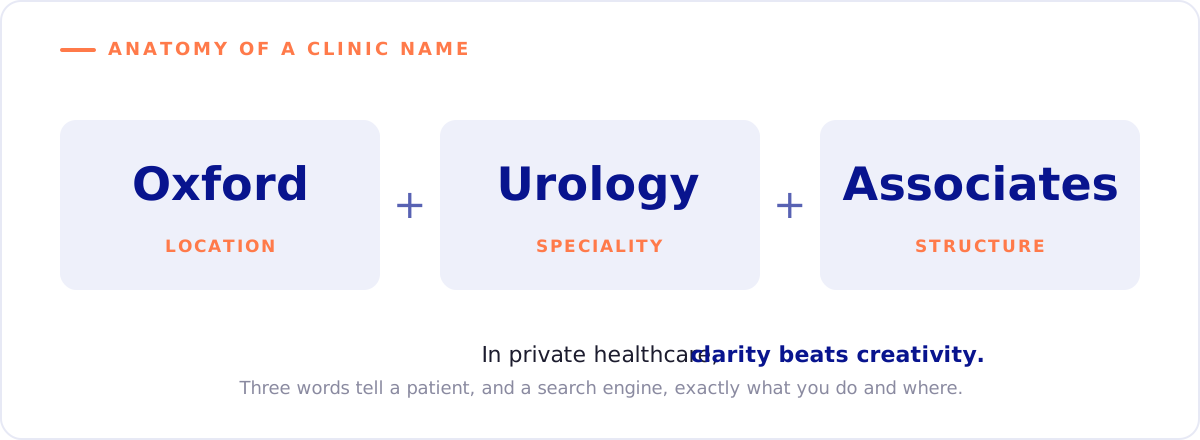
Ben and his founding partners chose it because it described exactly what they were: a group of urologists in Oxford. From a healthcare SEO standpoint, that’s close to ideal. When a patient searches for “urologist Oxford” or “urology clinic Oxford”, the practice name itself is a signal to Google, and the domain (oxfordurologyassociates.uk) reinforces that signal. There’s no guesswork about what the site is or where it operates, and that clarity has compounded over more than a decade.
This is worth getting right early, because it’s much harder to fix later. A clever, brand-led name can work brilliantly in other sectors, but in private healthcare, clarity tends to take precedence over creativity. Patients searching for a private dermatologist in Bristol, a urologist in Oxford, or a physiotherapist in Edinburgh are often making their first move toward booking. The clinics that make that search as direct as possible, in their name, URL and page titles, start with a structural advantage.
Ben’s practice got this right instinctively. “We saw how well it had worked in Reading,” he explains, referring to a group model he’d observed during training. “We thought that’s what we’d like to replicate in Oxford.” The name followed naturally from the model, and the marketing benefit has lasted over ten years.
Why one website beats several competing ones
As the practice grew, adding clinicians and expanding into Banbury, Milton Keynes, High Wycombe, and now toward Swindon, a familiar question arose: should each consultant have their own website?
Ben’s instinct was that the group site was working, but that individual consultant pages needed more depth. That’s the right diagnosis. Spinning up separate sites for each clinician is one of the most common and costly SEO mistakes we see in private practice.
When fifteen clinicians all practise urology, target similar keywords, and work in the same geography, a network of individual sites ends up competing with itself:
- Split authority: Domain authority that should be concentrated in one place gets divided across many.
- Diluted trust: The signals Google has built around the group domain get spread thin.
- Maintenance drag: Multiple sites rarely get the consistent upkeep they need to rank.
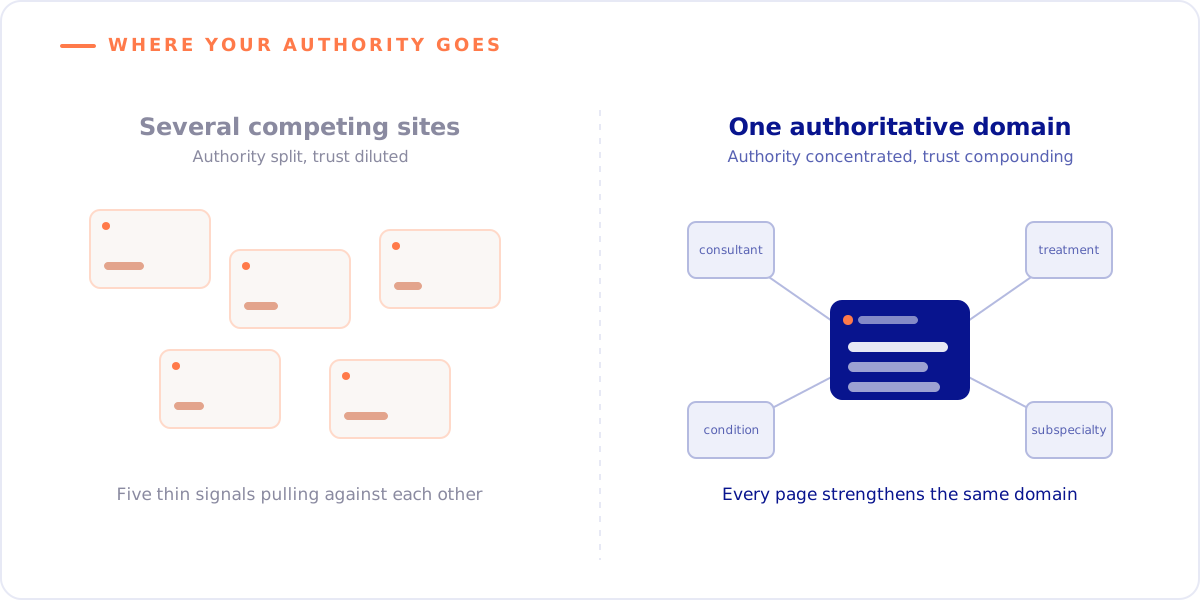
The fix isn’t more sites; it’s depth. A single authoritative group site with fully built-out consultant pages works far harder. Each clinician’s page includes their subspecialty interests, credentials, and clinical background, as well as links to the treatments they perform. Each treatment and condition page links back to the relevant clinicians.
When done well, the whole site becomes a web of mutually reinforcing authority: a subspecialty page surfacing cards for the relevant surgeons, and those surgeons’ pages pointing back to the conditions they cover.
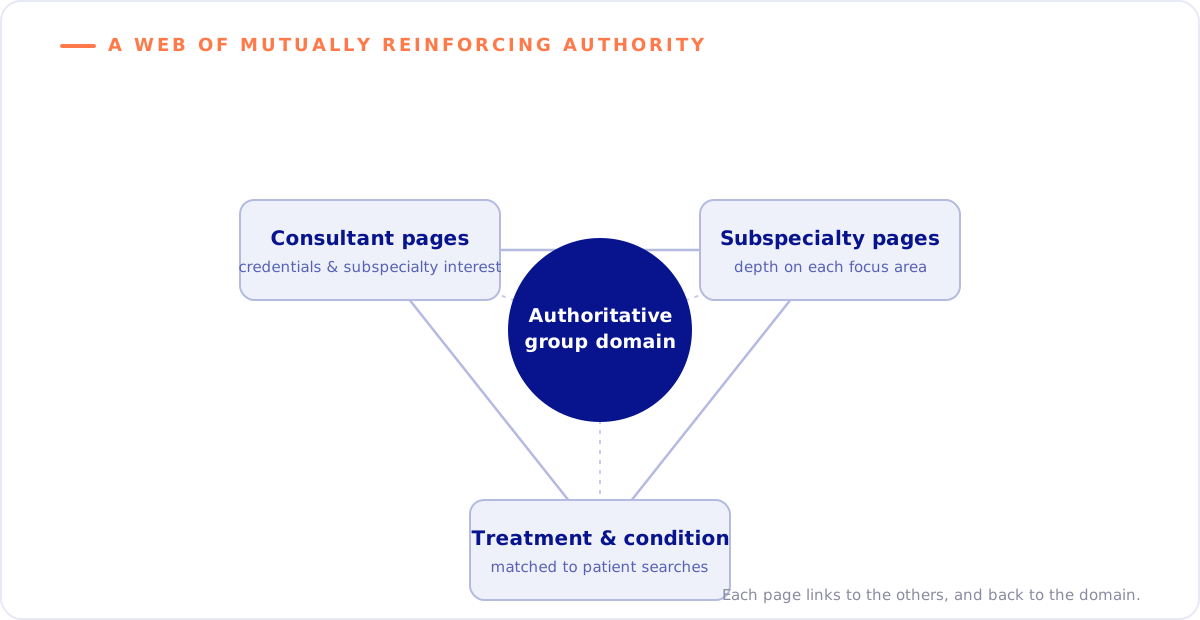
That structure is what lets a clinic in Oxford compete not just locally but nationally, and for high-value specialist searches, internationally.
The Oxford brand: a world-class asset with global reach
One of the most candid moments in our conversation came when Ben reflected on the University of Oxford affiliation. “It’s a massive brand,” he said, “which we don’t capitalise on at all really.”
It’s a remarkably honest observation, and it points to a gap that matters for any consultant with genuine institutional credentials: the distance between what colleagues know about your expertise and what a patient searching online can actually find.
This matters for two reasons.
First, trust signals are what AI-powered search uses to judge authority. When a patient asks an AI tool who the best kidney stone specialist in Oxford is, the answer is assembled from public signals: the website, the Docify profile, referenced publications and partnerships, the Google Business Profile. A clinician whose site clearly establishes their University of Oxford affiliation, research partnerships and role in introducing new treatments is building a case for ability, not just affability.
Second, institutional prestige has a global reach. It solves a geography problem Ben identified: the practice sits in a smaller market than London, but needn’t be limited by it. Oxford is under an hour from Heathrow, which regularly receives private jets from wealthy international patients drawn by lower landing fees than London airports.
There are lots of people coming in and out of Oxford all the time, and it’s got a world brand reputation.
That brand doesn’t need to be manufactured; it needs to be made visible: on the website, in the schema markup, in each clinician’s biography, and in content that explains their academic work alongside their clinical practice. When it is, a clinic in Oxford can compete for patients who’d otherwise default to Harley Street simply because it’s the name they recognise.
Your domain’s history is an asset, so protect it
Oxford Urology Associates has had the same website and the same phone number since launch in 2014: more than ten years of consistent signals pointing to one destination.
Domain age and consistency are among the factors Google uses to assess trustworthiness. A site that’s been indexed, updated and reliably tied to the same business, address and contact details for a decade is treated very differently from one rebuilt from scratch last year. Over those years, it accumulates backlinks, repeatedly indexed content, patient review signals and local citations: the raw material of domain authority, and none of it can be recreated quickly.
This has a practical implication if you’re weighing a rebrand or redesign. The aesthetics may need updating, the content refreshing, the structure overhauling, but the domain should almost always be preserved, with proper redirects in place if any URLs change. Moving to a new domain resets the clock to zero.
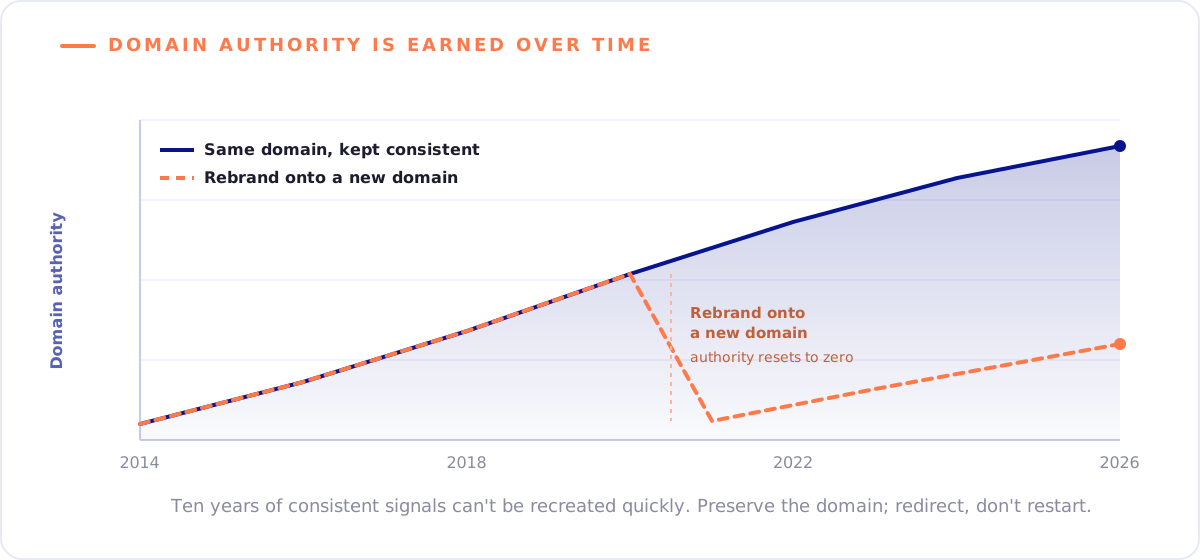
Ben’s practice has benefited from this without necessarily planning for it. “If you put Oxford and urology into a search engine, we kind of pop up straight away,” he told us. That’s not just because the site is good; it’s because it’s been consistently good, in the same place, for a long time.
Subspecialty pages: match search intent at the right level
One of the most underused structural decisions a clinic can make is to build separate pages for distinct conditions and treatments, each targeted at the right level of search intent. This is especially true if you intend to run Healthcare PPC campaigns.
A patient searching “prostate cancer specialist Oxford” is in a very different place from one searching “what are the symptoms of BPH”. Both might eventually see the same clinician, but they’re asking different questions and need different answers. A single page trying to serve both usually serves neither.
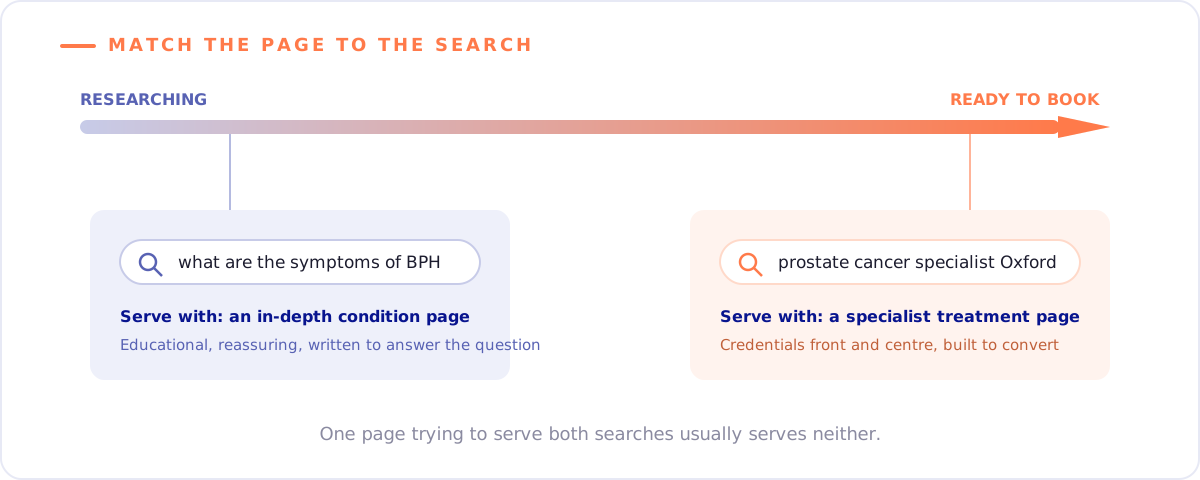
The subspecialty model forces this structure naturally. Ben doesn’t manage prostate cancer; a patient with that diagnosis gets referred to the colleague who does. That clinical clarity maps directly onto the page structure that works best for SEO: a kidney stones page that goes genuinely deep on kidney stones, written for the patients searching for exactly that, with Ben’s credentials as a high-volume specialist front and centre, linking across to the BPH page where his other interest sits.
Every urologist retains a sub-speciality interest. So if I see a patient with prostate cancer, I don’t manage prostate cancer. I’d refer them on to my colleague so they get that subspecialty opinion. Which is much better for the patient, really.
It’s much better for search, too. A patient who lands on the right page from the right search, and sees a clinician who clearly handles high volumes of their exact problem, converts. For clinics earlier in their journey, this is one of the highest-leverage SEO investments available: a healthcare SEO specialist can map which conditions and treatments deserve their own pages, what the search volumes look like, and how to route each type of intent to the right place.
The group model raises your marketing ceiling
There’s something else in Ben’s story worth drawing out for founders deciding between solo and group practice: the group model doesn’t just change how a practice operates, it changes what it can become, commercially and reputationally.
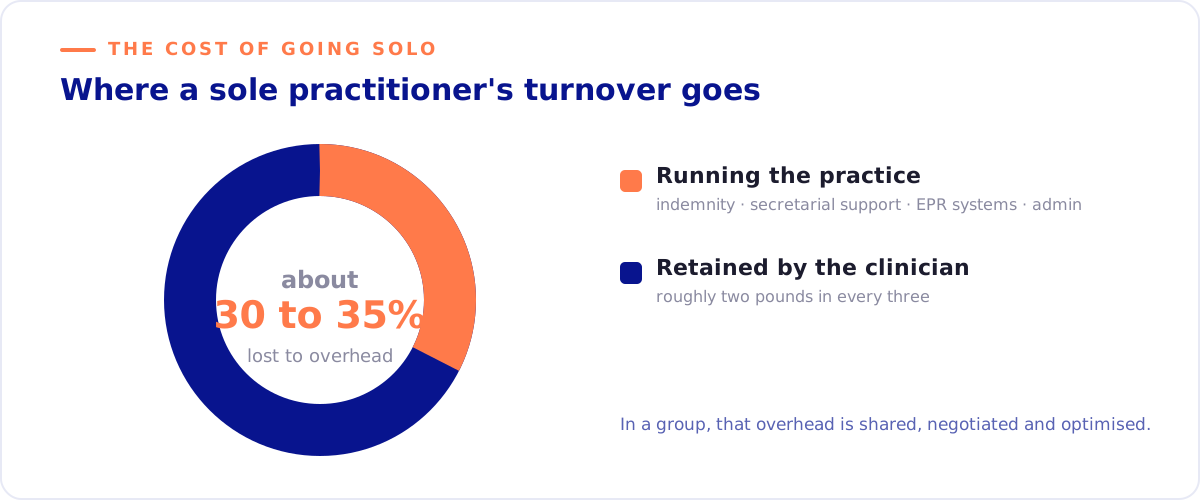
Ben is direct about the economics. “We know from the data that probably about 30 to 35% of a sole practitioner’s turnover is spent on running the practice. For every pound you earn, about 30 to 35 pence disappears in admin and costs: indemnity, secretarial support, electronic patient record systems, all the rest of it.”
The decisions you can’t easily undo
What ties all of this together is simple: the decisions that matter most for marketing are often made before marketing is even on the agenda, and they’re far harder to fix later than to get right now.
- Your name sets what your URL says and how easily patients find you in local search.
- Your domain is the authority you’ll spend the next decade building.
- Your site structure, grouped or fragmented, siloed by subspecialty or lumped together, works for you or against you every day.
- Your phone number from that first listing should still be on your site ten years later.
Ben’s practice got most of these right, largely by instinct, by observing a model that worked in Reading and replicating it in Oxford. That’s a more common pattern than you might think: sound early clinical decisions that also happen to be excellent marketing ones. The result, twelve years on, is a practice that ranks consistently, attracts patients nationally and internationally, and has the domain authority to keep growing.
What to do next
Most of these foundations can be audited, diagnosed, and improved, even for practices that have been running for years. What can’t be recovered is time: the domain authority that wasn’t being built, the subspecialty pages that weren’t capturing searches, the credentials that weren’t visible to AI.
The best time to get this right is at the start. The second-best time is now.
If you’d like to understand where your clinic sits against these foundations, what’s working, what’s missing, and where the opportunity lies, we’re happy to take a look. Get in touch with the team.
With thanks to Professor Ben Turney, Managing Partner of Oxford Urology Associates, for sharing his experience building one of the UK’s leading private urology group practices.