
Why Your Practice Management Software Is a Marketing Decision (Not Just an Ops One)
Most clinic founders come to us thinking the same thing: “We need more patients.” And they’re right, they do. But when we start pulling at the thread, where are leads coming from, what’s the cost per acquisition, how is conversion tracking working, we often find the same thing sitting underneath the marketing problem.
The operational system.
Specifically, the practice management software (PMS) that’s supposed to hold the whole patient journey together. And more often than not, it’s either the wrong one, badly configured, or doing about a fifth of what it should be.
We sat down with Nikita Symes, COO at Carebit, a practice management software for consultants in private practice, to understand this from the ground up. Nikita works directly with clinic founders and practice managers every day, and what she shared reframed how we think about this problem for a lot of our clients.

The misconception that’s costing clinics real money
There’s a really common pattern we see: a clinic invests in SEO or PPC, starts generating enquiries, and then struggles to connect any of that activity to actual patient bookings or revenue. The marketing team is frustrated because they can’t demonstrate ROI. The founder is frustrated because they’re spending money and can’t see where it’s going.
Nine times out of ten, the culprit isn’t the campaigns. It’s the operational system underneath them.
Nikita sees exactly this from the other side. “Most people underestimate how much their system shapes how their clinic actually runs,” she told us. “A practice management software is often seen as a place to store patient records or manage bookings, something functional rather than foundational. But in reality, it defines how your practice runs. It’s the backbone.”
The backbone is doing a lot of work. And it’s worth unpacking what it actually means in practice.
What a PMS actually does when it’s working properly
According to Nikita, when a PMS is truly functioning as the operational spine of a clinic, it isn’t just storing records and sending reminders. It’s connecting every stage of the patient journey, from first booking through to billing, reporting, and recall, so that information flows automatically rather than relying on memory, manual processes, or spreadsheets held together with goodwill.
She describes it this way: “Think about the backbone in the human body. Everything flows from it: your senses, your movement, your whole body functions through that backbone. That is what your practice management software should be. Everything flows through that system. From the first booking or patient registration, to letters going out, to billing, to reporting, the practice management system should be where all of those processes connect.”
Your practice management software is the backbone of your practice.
Nikita Symes, COO at Carebit
When that’s working, the clinic knows in real time which patients are coming in and when, where bookings are coming from, what’s been invoiced and what’s outstanding, which follow-ups need to happen, and how capacity is being used across clinicians and rooms. Clinicians trust what’s in front of them. Admin teams work from process rather than memory.
And this is where it connects directly to marketing, founders can finally see which acquisition channels are actually producing patients, not just leads.
Professor Ben Turney, consultant urological surgeon, Associate Professor at Oxford, and managing partner of Oxford Urology Associates, a fifteen-clinician group practice, described what changed when they made the switch to a modern PMS. “I routinely use ambient AI now in my clinics to basically summarise the consultation, and then that will produce a draft letter within a few seconds of the patient finishing the consultation. Usually by the time they’ve got to their car to leave the hospital, I’ve been able to proofread the letter and email it to them and to their GP. Patients are astonished.” That kind of operational speed is what patients now expect. And it only happens when the right system is in place.
Where the marketing data problem lives
Here’s the connection that most agencies won’t explain clearly, because they’re not thinking about it from an operational standpoint.
Your marketing attribution: knowing that Patient A came from a Google search, booked because of your rhinoplasty page, and then spent £3,800 on treatment, only works if there’s a clean, reliable system capturing the journey from enquiry to appointment to payment. If billing is delayed, if patient records are duplicated, if referral sources aren’t being logged consistently, that data gets muddied or lost entirely.
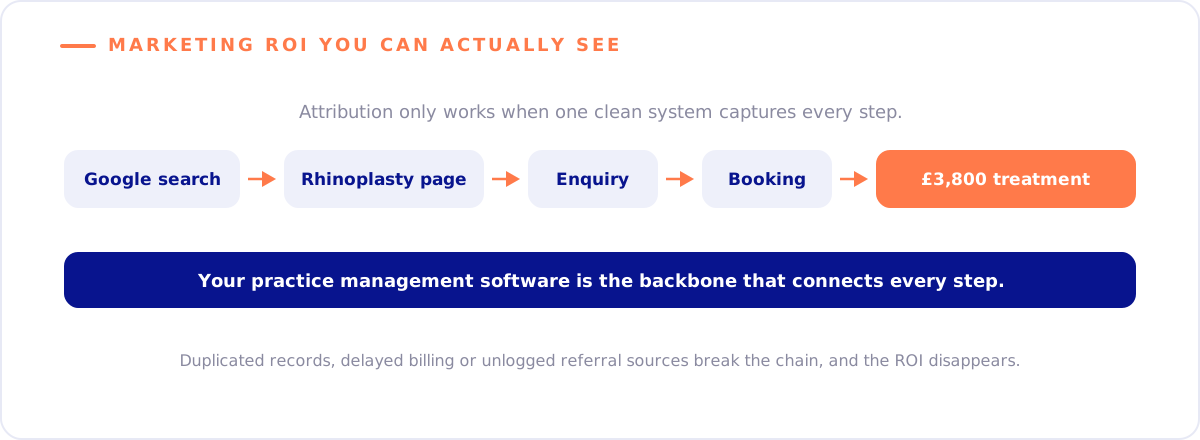
Nikita is direct about why this happens. “If clinics feel like they’re flying blind, it could be because they don’t trust the data due to bad historical experiences, or because the data isn’t structured in a way that’s meaningful. You’re looking at all this information but it’s not actually contributing to good decision-making.” She’s clear that this isn’t a reporting problem it’s a systems problem. “The only way you can trust the output is if you’ve got all the information entered into the system correctly from the beginning.”
At KD Web, we track the full patient journey: from the keyword that first brought someone to your site through to the revenue they generate. But that work is only as good as the operational data we’re connecting it to. This is why we’ve started having PMS conversations earlier with clients. Not because we’re practice management consultants, but because when a clinic’s operational system is properly set up, our marketing work becomes significantly more effective.
The tipping point: when do you outgrow spreadsheets?
Sooner than you think, according to Nikita, and the signal isn’t always obvious.
“A solo practitioner could run on spreadsheets for a certain amount of time,” she explains. “But the moment you introduce different revenue streams: self-pay and insurance billing, multiple locations, new clinicians, increasing patient volume from different channels, manual systems start to break down. The tipping point is where you can no longer confidently answer basic questions about bookings, billing, or patient inquiries because there’s just too much to manage across multiple places.”

It’s a pattern Ben Turney knows well. Before switching systems, Oxford Urology Associates was running a process where letters were dictated, sent to an external transcription service, returned for proofreading, and then sent out. “The turnaround time for a letter would be sometimes two or three days by the time someone had typed it and then we’d had a chance to go back and review it. It just became increasingly inefficient.” That inefficiency is exactly what Nikita describes: the tipping point where the cost of manual systems outweighs the cost of replacing them. The pain just tends to arrive quietly, long before it becomes obvious.
What makes this tricky is that the quiet friction compounds. Things get missed. Billing slows down. Follow-ups fall through the cracks. The admin team starts compensating for the system, and that compensation becomes a hidden cost. “Everyone is almost in a kind of state of panic all the time,” Nikita says, “but because things are busy, you think it’s the norm. But it shouldn’t be.”
Her view, and one we’d strongly echo from the marketing side, is that the best time to implement a proper PMS is before you feel like you need one. “The sooner you can have that implemented, the easier your growth is going to be, the easier the admin is going to be, and the better the patient experience will be.”
What good looks like (and why it matters for patient experience too)
It’s easy to frame PMS purely as an internal efficiency tool. But as Nikita points out, patients experience the consequences of your operational system at every stage of their journey, they just don’t see the system directly.
“Patients rarely see the system directly, but they feel the effects at every point in the patient journey,” she told us. “How easy it is to book, how clear the communication is, whether information is consistent, how smoothly their follow-up happens. When systems are well-designed, patients feel guided. They feel reassured. They don’t need to seek assurance.”
When systems are fragmented, the inverse is true. Inconsistent communication. Delays. Admin staff who can’t answer patient questions because they’d have to check three different places to find the answer. Clinicians who don’t trust the data in front of them.
Ben Turney puts it well from a clinician’s perspective: “If you’re trying to phone up and you can’t get a reply, or leaving voicemail messages and it takes a while for someone to respond, you just lose confidence in the whole system a little bit. Our goal has basically been to make it easy for patients, because if you’re unwell or you’re in pain, the last thing you want is to go through barriers to get the help you need.” That’s not a marketing insight, it’s an operational one. But the two are inseparable.
We asked Nikita what good actually looks like when everything is working. Her answer was immediate: “Calm. When a clinic feels calm, that’s what good looks like. Patients feel guided and reassured. Admin teams know exactly what they need to do and when. Clinicians trust the schedule. Billing flows naturally. The system absorbs complexity rather than exposing it.”
That kind of calm is what makes great marketing sustainable. You can generate as many enquiries as you like, but if the experience on the other side doesn’t match the promise, you’re burning through your reputation along with your budget.
A quick note on PMS vs CRM, and why it matters
One thing that comes up often with clinics scaling their marketing properly is where practice management ends and CRM begins. Nikita draws the line clearly.
“A CRM is handling the relationship before that individual becomes a patient. The practice management software is handling that relationship after. So prior to becoming a patient it could be inquiries, general information, segmentation for marketing, and then as soon as that individual converts to a patient and makes a booking, that’s where it hands over to patient record management.”
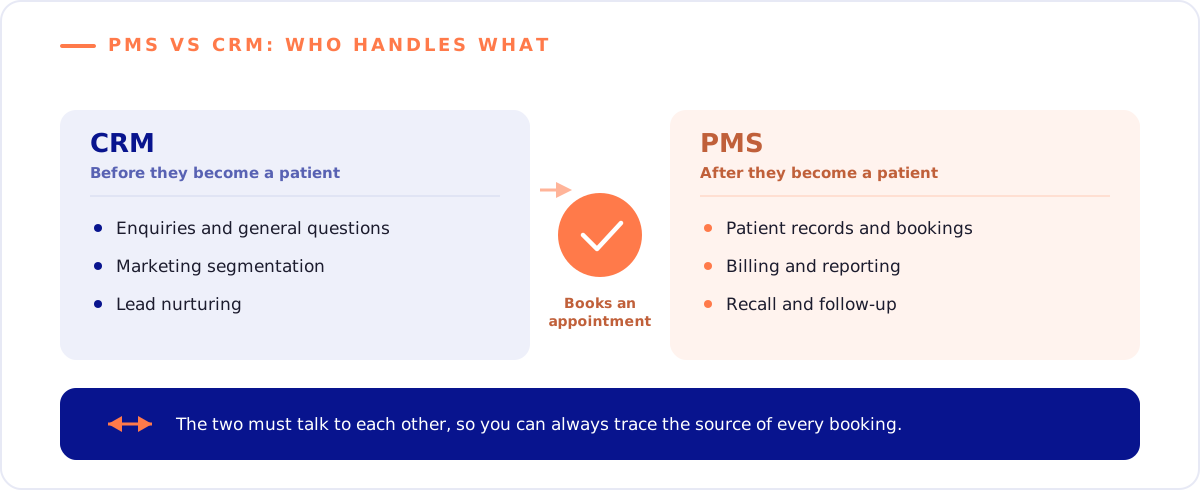
For a solo practitioner or small clinic, Nikita notes that a good PMS often has enough CRM functionality built in to cover the early stages without needing a separate tool. For a larger clinic with multiple specialties and varied marketing channels, a more robust CRM alongside the PMS is likely worth it, but the two need to talk to each other. “If they can talk to each other, that’s going to be massively more advantageous for the practice,” she says. “You want to always be able to see the source of your bookings, the source of your patients, and repeat activity, and that’s going to best position you to make the correct marketing choices going forward.”
This is precisely where the marketing and operational worlds connect. The data that flows between your CRM and your PMS is what makes attribution reliable. Without that handover working cleanly, marketing spend becomes very hard to evaluate.
The practical question: how do you get this right?
This is where Nikita is especially useful, because she’s done the configuration conversation hundreds of times with clinic founders at very different stages.
Her starting point is always the service structure. “Ensuring that your services are set up correctly: what services do you provide, how much do they cost, when do you provide them, and where, that diary and scheduling structure is the absolute bedrock of how your practice is going to be managed. If you get that right from day one, everything else flows a lot easier.”
From there, she points to two things clinics consistently underestimate. The first is automation. “Setting up the automation to provide predictable communication to your patients, mapped to your patient journey, not just configured on a setting-by-setting basis. These things may seem small, but as your clinic grows and you see more patients and have more bookings, it’s going to shape things downstream.” The second is standardisation across the team. “Each person may do things a little bit differently, but the practice management software should be configured in a way that best practices are always followed. The patient has the same journey and the same experience even if the admin team are doing things slightly differently. The system provides the guard rails.”
The most common mistake she sees? Treating configuration as a one-time task rather than thinking ahead. “Set it up for where you want the clinic to be in a year’s time or two years’ time. Really think about how you’re setting up your services, how you’re creating the automation, not just the settings you need today.”
For KD Web, this is where the marketing and operational conversations start to overlap. If a clinic is tracking capacity, billing speed, and revenue by service type properly, we can connect that picture to acquisition channel performance and start to see where the real growth opportunities are, and where spend is going to waste.
What this means if you’re working with us
We help private clinics grow through digital marketing: SEO, PPC, CRO, and the kind of connected reporting that lets you see exactly how your marketing investment is translating into patients and revenue.
But we work best, and deliver the strongest results, when the operational foundation underneath that marketing is solid. Not perfect. Just structured and reliable.
If you’re a clinic in an early stage of growth, or you’re reviewing a setup that’s not quite working, we’re happy to have a conversation about where the gaps are and what the right next step looks like. Sometimes that’s purely a marketing conversation. Sometimes it starts with a systems question.
Either way, we’d rather help you build something that actually works than sell you activity that doesn’t connect to revenue.
With thanks to Nikita Symes, COO at Carebit, whose expertise on private practice management informed this piece, and to Professor Ben Turney, Managing Partner of Oxford Urology Associates, for sharing his perspective as a clinician and group practice operator. If you’d like to explore Carebit as a practice management platform for your clinic, you can find them at carebit.co.