
Your Guide to a Patient-Focused Healthcare Marketing Strategy
Marketing in healthcare has changed. It’s no longer about crafted brochures or having a good reputation with GPs: patients are online, searching, comparing, and reviewing before they ever step through your doors. Whether you’re running a private clinic or managing a wider healthcare organisation, how you communicate with patients digitally can make or break their decision to choose you.
This guide is designed to help you develop a clear and practical marketing strategy centred on what matters most: your patients. We’ll walk through what makes healthcare marketing different, how to build trust online, and which digital channels move the needle. Whether you’re starting from scratch or refining your existing approach, the aim is the same: to attract the right patients, improve their experience, and support better outcomes across the board.

What is healthcare marketing?
Healthcare marketing is about connecting the right people with the right care. It’s how you ensure potential patients can find you, understand what you offer, and feel confident enough to take the next step — whether that’s booking an appointment, asking a question, or simply remembering your name when they need you.
That means your marketing strategy for healthcare needs to be thoughtful, ethical, and genuinely helpful. A good strategy provides structure to everything, from the way you discuss your services, to where you appear online, to how you manage reviews.
In the UK, while the NHS remains a central part of the healthcare system, private healthcare is becoming an increasingly significant component. Private care now makes up over 8% of the market, and it’s growing. In Q1 2024 alone, there were nearly 240,000 private hospital admissions, a record high. Much of this growth stems from the aftershocks of COVID-19, which created a huge care backlog and pushed many patients to seek quicker, more personalised options.
For private clinics and healthcare providers, that means one thing: if you want to stand out, you need a smart, focused marketing strategy for healthcare that makes it easy for patients to find and trust you.
But healthcare marketing comes with a different set of rules. You’re speaking to people who may be anxious, overwhelmed, or in pain. That means every touchpoint needs to be clear, empathetic, and respectful. You’re also operating in a tightly regulated environment, where accuracy and ethics matter just as much as creativity. From handling personal data under GDPR to avoiding misleading claims, the stakes are high.
The importance of marketing in the healthcare sector
Healthcare has always been about care first, but in today’s environment, it also has to be about communication. Patients nowadays search online before booking, compare services, read reviews, and ask peers for recommendations. If your organisation isn’t showing up in those moments, with clear, accurate and reassuring information, you’re already behind.
A well-thought-out digital marketing strategy for healthcare makes sure you’re visible at the right time, in the right places. It helps patients understand what you offer, why they should trust you, and how to take that next step.
Why do medical companies need a marketing strategy?
Effective marketing builds credibility, supports your reputation, and can even enhance the overall patient experience, especially when supported by helpful content, seamless online tools, and consistent messaging across channels.
For healthcare organisations, this is about more than visibility; it’s about sustainability. A strong marketing strategy for healthcare supports patient acquisition while also helping you stay relevant, navigate competitive pressure, and adapt to changing patient needs. Especially for private clinics or growing medical practices, marketing isn’t a ‘nice to have’, it’s a critical part of delivering modern, accessible care.
Step-by-step guide to a foolproof healthcare marketing strategy
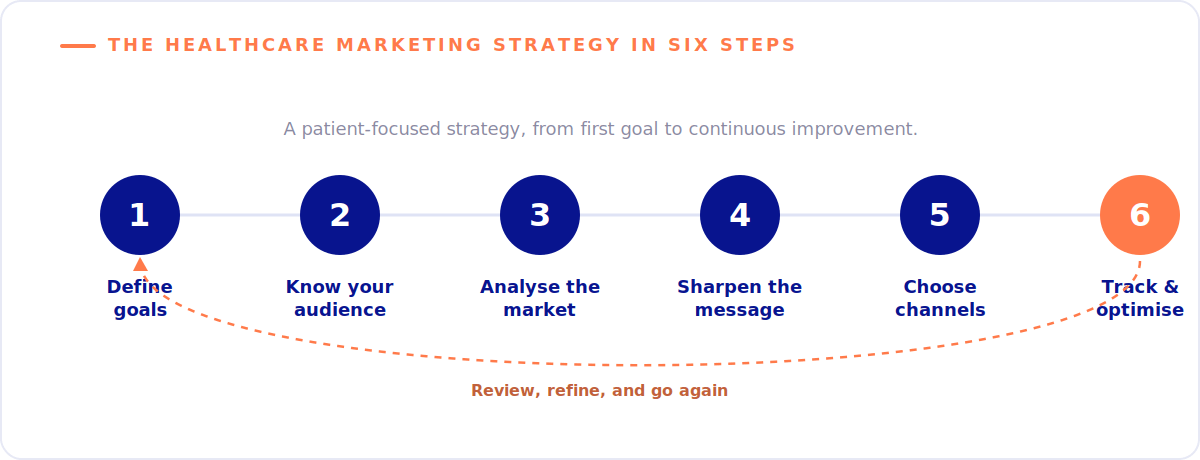
Define your goals and objectives
Before you touch an ad or piece of content, be clear on what success looks like. Are you trying to attract new patients, increase bookings for a particular service, improve your online reputation, or raise awareness in a specific region?
Set measurable goals that are realistic but meaningful. A solid healthcare marketing strategy should tie directly to business outcomes, not just vanity metrics like impressions. Think in terms of new consultations, repeat visits, website conversion rates, or reduced patient churn.
Using SMART goals (Specific, Measurable, Achievable, Relevant, Time-bound) will help keep your team aligned and focused on outcomes that matter, both to your organisation and to your patients.
Identify your target audience
You cannot target “everyone”; you’re speaking to individuals with specific concerns, needs, and expectations. Who are you trying to reach?
Consider factors like age, location, condition, health literacy, and preferred communication channels. For example, the way you market fertility services will differ significantly from how you promote orthopaedics or mental health support.
Build clear audience personas. Include motivations (why are they looking for help?), barriers (what might stop them from contacting you?), and their typical journey (how do they find and choose a provider?). This ensures your messaging hits the mark and your content genuinely supports their decision-making process.
Conduct market and competitor analysis
Before defining your approach, take a step back and look at what’s already out there. What are other providers in your space doing well, and where are they falling short? Which keywords are they ranking for? What kind of content are they creating?
A proper competitor analysis helps you identify where the opportunities lie. Perhaps your local competitors have invested heavily in PPC, but their SEO efforts are weak. Or maybe they haven’t fully embraced patient stories or educational content in a meaningful way. That’s your opening.
Don’t stop at competitors, assess the broader market, too. Are there emerging trends in the healthcare sector you should address? What are patients complaining about in reviews or forums? Build your strategy on insights, not assumptions.
Establish key messaging and brand positioning
Patients don’t just want to know what you do, they want to know why they should choose you. This is where clear, consistent messaging makes all the difference.
Start by defining what sets you apart. Is it your approach to care? Your speed of access? What is your focus on specific conditions or patient groups? Whatever your edge is, build your messaging around it and ensure it runs through everything, from your homepage to your email footer.
Keep it human. Avoid jargon. Speak in the language your patients use, not what’s on your referral form. This is especially important when creating content or running a marketing campaign across digital channels. If it doesn’t sound like you or feel like it was written for them, it won’t stick.
Choose the right marketing channels
No single channel will do all the work. You need a mix that reflects how patients seek information. Here’s a breakdown of key options to consider:
SEO (Search Engine Optimisation)
Over 5% of all Google searches are health-related. Strong SEO ensures your website and content show up when patients are researching symptoms, treatments, or local providers. Focus on high-intent keywords, local search, and service-specific landing pages.
PPC (Pay-Per-Click Advertising)
For time-sensitive services or competitive locations, paid ads can deliver quick results. Use Google Ads or Microsoft Ads to target high-converting search terms. Track conversions carefully, especially in healthcare, relevance and intent are everything.
Social Media
Platforms like Facebook, Instagram, and LinkedIn offer a way to build trust, highlight your team, and share educational content. For private practices, social media also supports word-of-mouth and local reputation building.
Email Marketing
Email remains one of the most cost-effective ways to stay in touch with patients. Use it for appointment reminders, seasonal health tips, post-care check-ins, and newsletters, but only where there’s real value, not noise.
Set up tracking and analytics
If you’re not measuring it, you can’t improve it. From Google Analytics to call tracking and CRM integrations, make sure you’ve got the right tools in place to track the impact of your campaigns.
Look beyond basic traffic numbers. Measure conversion rates, bounce rates on key service pages, cost-per-lead from PPC, email open rates, and performance by channel. This is where a data-driven approach becomes your competitive advantage.
It also helps prove ROI, something your leadership team or stakeholders will care about, especially if you’re allocating a significant budget.
Healthcare marketing regulations
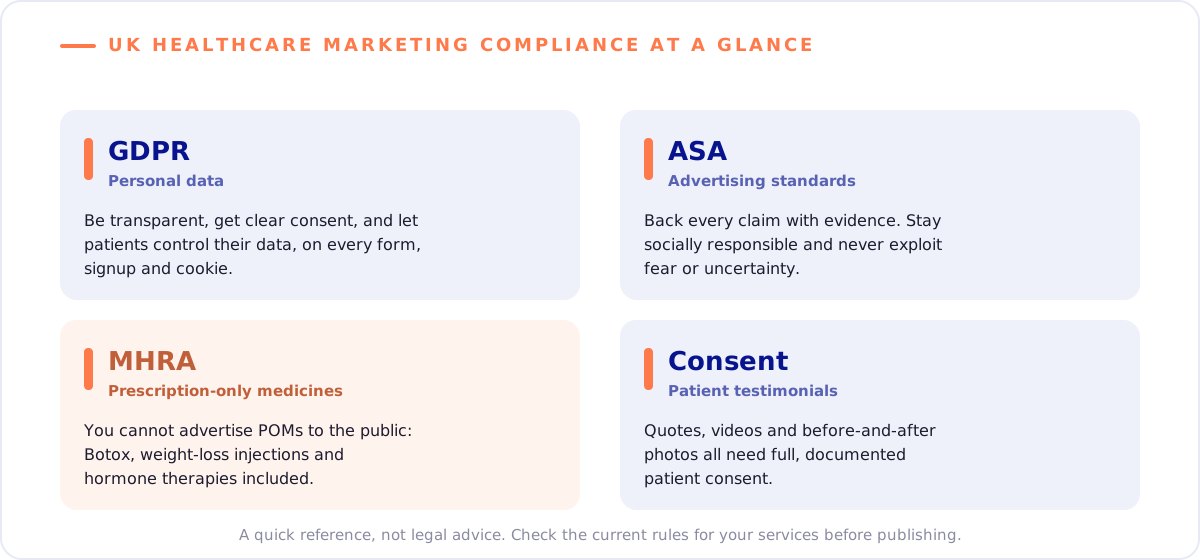
The UK has strict regulations in place to protect patients and ensure that healthcare information is accurate, respectful, and secure.
If you’re collecting any personal data, whether through appointment forms, email signups, or cookie tracking, you must comply with GDPR. This means being transparent about how data is used, obtaining clear consent, and giving patients control over their information.
The ASA oversees all advertising in the UK, including digital campaigns, website copy, social media posts, and even patient testimonials. Claims about treatments must be backed by evidence, and ads must be socially responsible and not exploit fear or uncertainty.
If your organisation offers services involving prescription-only medications, such as Botox, weight loss injections, or hormone therapies, you cannot advertise those directly to the public. This is a legal restriction enforced by the MHRA (Medicines and Healthcare products Regulatory Agency), and breaching it can result in serious consequences.
Showcasing patient testimonials can be powerful, but only if done with full, documented consent. This applies to written quotes, video content, before-and-after photos, anything that features or references a patient’s experience.
Every piece of content, every ad, and every email you send must be compliant with the relevant regulations. It’s not just about protecting your business but also protecting your patients and the trust they place in you.
Best practices for healthcare marketing
You’ve got your strategy in place. You understand your audience. But how do you execute in a way that builds trust, brings in patients, and stands up to scrutiny? These best practices will help you focus on what works in healthcare marketing.
Build a Website That’s Designed Around Patients
Your website is the first real interaction someone has with your brand. It needs to load quickly, be easy to navigate, work on mobile, and make booking or contacting you simple.
Beyond the basics, it should answer real questions: What services do you offer? Who are your specialists? What do patients say about their experience?
Manage Your Online Reputation
In healthcare, reputation is everything, and much of it lives online. Patients regularly check Google reviews, Trustpilot, or even Facebook comments before choosing a provider. A handful of poor or unanswered reviews can undo a lot of good work.
Encourage satisfied patients to leave honest reviews and respond to all feedback professionally, including the more challenging ones. Showing that you listen and care goes a long way in reinforcing trust.
Real stories resonate. Sharing genuine patient testimonials, with full consent, helps others understand what their own experience might be like. Whether it’s a short quote on your homepage or a longer video story, this kind of social proof builds confidence.
Create and Share Educational Content
One of the most effective approaches to healthcare content marketing is education. Patients are seeking answers about symptoms, treatment options, recovery times, risks, and other related questions. If your organisation can provide those answers clearly and calmly, you immediately position yourself as trustworthy.
Think articles, FAQs, explainer videos, downloadable guides, or even short tips on social media platforms. Focus on being useful, not salesy.
Structure your site so that every key service has its own page, optimised with relevant keywords and clear pathways to action. Don’t forget your Google Business Profile; it plays a huge role in local search visibility.
Every word, image, and video you publish shapes how patients perceive you. Use real photos where possible, of your team, your practice, your space.
Implement a multi-channel strategy
Patients don’t all use the same platforms, so your healthcare marketing strategy shouldn’t rely on just one. Combine organic and paid channels across search, social, email, and even offline when appropriate.
For example:
- Use SEO and blog content to capture research-stage traffic
- Run PPC ads for immediate appointment-based keywords
- Share updates and stories via social media
- Use email to stay in touch after a first visit or enquiry
When your messaging is joined-up across channels, the patient journey feels smooth and professional.
Monitor and optimise regularly
Patient needs shift, platform algorithms change, and what worked last year might not cut it today.
Track performance at every level, from ad spend ROI to which blog posts are generating enquiries. Use that data to make smart adjustments, test new ideas, and continuously improve. Regular optimisation is what turns a good strategy into a great one.
Results of a good marketing strategy
When your approach is aligned, consistent, and rooted in the real needs of your audience, you become visible. Patients can’t choose you if they don’t know you exist. A solid strategy ensures your name appears where it matters, on search engines, social platforms, review sites, and more, so people start recognising your brand and associating it with reliable care.
A joined-up digital presence supports the journey from the first click to a confirmed appointment. A thoughtful website, reassuring messaging, and friction-free booking process all help turn interest into action. Patients are far more likely to commit when they trust what they see and feel guided throughout the experience.
Regular, relevant communication builds trust over time. When patients feel understood and respected, they’re more likely to return, recommend you to others, and leave positive online reviews.
Most importantly, when your strategy is data-led and well-executed, you get more from your marketing spend. Rather than chasing trends or reacting to pressure, you’re making informed, strategic decisions that drive real results, and that’s what every healthcare leader wants to see.
How can we help you employ effective healthcare marketing?
You know marketing matters, but finding the time and expertise to get it right isn’t always easy.
KD Web has been helping organisations grow online for over 25 years, long before digital marketing became the norm. As one of the first agencies in the UK to offer SEO as a core service, we’ve been refining our approach ever since.
Today, we bring that experience to healthcare providers who need a partner that understands the complexity of the sector and the expectations of modern patients.
Whether it’s building a fast, patient-friendly website, improving your visibility through search, running targeted PPC campaigns, or strengthening your presence across social media platforms, we work as an extension of your in-house team. We slot in where you need us most, giving you the digital support to free up your time for strategic work.
We’re results-driven, transparent, and collaborative. That means you’ll always know what we’re doing, why we’re doing it, and how it’s performing. And because we understand the unique sensitivities of healthcare marketing, from regulatory compliance to tone of voice, you can be confident that your strategy is not only effective, but appropriate and patient-first.
If you’re ready to take a smarter, more structured approach to healthcare marketing, we’re ready to help you make it happen.