
How to Market a Nursing Home Ethically and Effectively in the UK
Marketing a nursing home is a high-trust sale, often made at short notice. Families want evidence that your home is a safe, well-run place to leave a relative, and they want it quickly.
This guide covers how to earn that trust and win the right enquiries, without pressure or claims you cannot stand behind.

Why Nursing Home Marketing Needs a Different Approach
Care home marketing has to do two jobs most sectors keep separate. It has to reach families directly, and it has to earn the confidence of the professionals who refer families to you: GPs, hospital discharge teams, and social workers. Each audience reads different signals, so a strategy aimed only at families leaves half your growth untouched.
You also control your reputation less than in most sectors. A CQC rating, an inspection report, and reviews on sites like carehome.co.uk shape how families see you before they reach your website. Much of the work is influencing and evidencing those external signals rather than making your own claims. Growth comes from reputation and referral, which is why professional relationships and word of mouth matter more here than in almost any other service. Effective nursing home marketing runs on evidence, responsiveness, and transparency instead.
Digital Marketing Tactics That Build Trust
Your Website
Your website is where most families form their first impression, so make it fast, mobile-friendly, and easy for older users to navigate. Then give them what they came for: your services, your fees or fee ranges, your CQC rating linked to the full report, and your staff’s qualifications.
Real photos of rooms and communal spaces, a virtual tour, and short video testimonials from consenting residents or families do more than any stock imagery. Put your phone number on every page, add a simple enquiry form, and commit to a response time you can keep.
Local SEO and Google Business Profile
Most searches start on Google and are local and specific: “nursing home near me,” “dementia care in [town],” “respite care [area].” If you are not in those results, you are not in the running.
Claim and complete your Local SEO profiles, keeping your address, phone number, hours, and category consistent everywhere they appear. Add photos, post updates, and reply to reviews. Ask satisfied families to leave one after a respite stay or a smooth admission, and make it effortless with a direct link. List the home on the directories families actually search, such as carehome.co.uk and Lottie, which rank well and carry their own weight.
H3: Paid Search (Google Ads) With Call Tracking
PPC marketing puts you in front of families when they are searching. Target specific, high-intent terms (“nursing home near me,” “dementia care [town],” “short-notice placement [area]”) and write ads that reassure rather than push: “CQC Good rated,” “short-notice placements available,” “speak to our admissions team today.”
The setting that changes everything is call tracking. Most care enquiries come by phone, so without it you cannot tell which keywords and ads produce real conversations rather than wrong numbers.
Community Engagement and Local Presence
The referrers named earlier – GP surgeries, hospital discharge teams, social services, and community mental health teams – decide which homes families hear about first. Those relationships are built in person, and so is a local reputation: supporting dementia cafés and carer groups, hosting open days and plain-English sessions on navigating fees or a care assessment, and showing up at local health events. None of it produces an enquiry this week. Over time it makes your home the one professionals and neighbours name without being asked.
Managing Your Reputation (and Your CQC Rating)
Your CQC rating is the first thing most families check. If you are rated Good or Outstanding, put it where families will see it: your site, your profile, your ads, your email signature.
Measuring What Matters
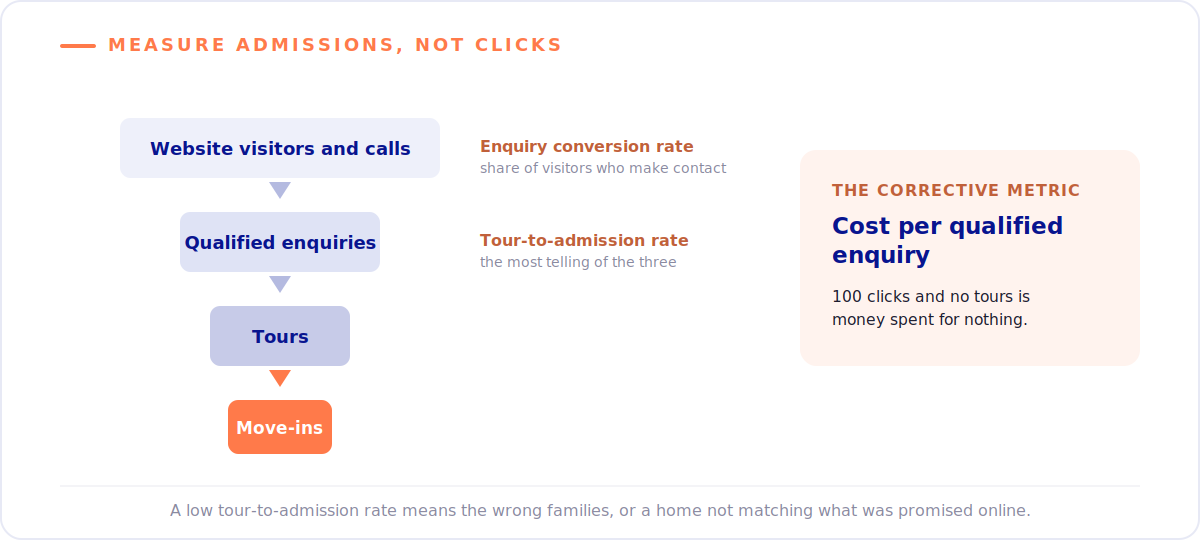
Judge your marketing on enquiries and admissions, not clicks and impressions. The numbers worth watching are your enquiry conversion rate (the share of visitors who make contact), your tour-to-admission rate (the share of in-person visitors who move in), and your cost per qualified enquiry. That last one is the corrective to vanity metrics: a hundred clicks and no tours is money spent for nothing, while ten genuine enquiries and five admissions is a campaign doing its job.
Your tour-to-admission rate is the most telling of the three. If it is low, either your marketing is attracting the wrong families or your online presence is promising something the home does not deliver in person. Use GA4 and call tracking together to follow the whole journey from first search to move-in, rather than counting isolated visits.
Where To Start
Marketing a nursing home well is not about filling beds faster. It is about being easy to find, straightforward to trust, and honest about what you offer, so the families who are right for your home choose it and the ones who are not do not arrive disappointed. Get that right and the reputation compounds in your favour.
If you would like help building a healthcare marketing strategy that protects your reputation while driving sustainable growth, KD Web’s consultancy-led approach pairs sector expertise with measurable delivery.