
SEO for Chiropractors: How Healthy Is Yours in the Age of AI?
In this guide:
Chiropractic SEO used to be simple: publish pages and posts, target the right keywords, and rank for the questions patients ask. That playbook now works against you, because AI has changed where the value sits.
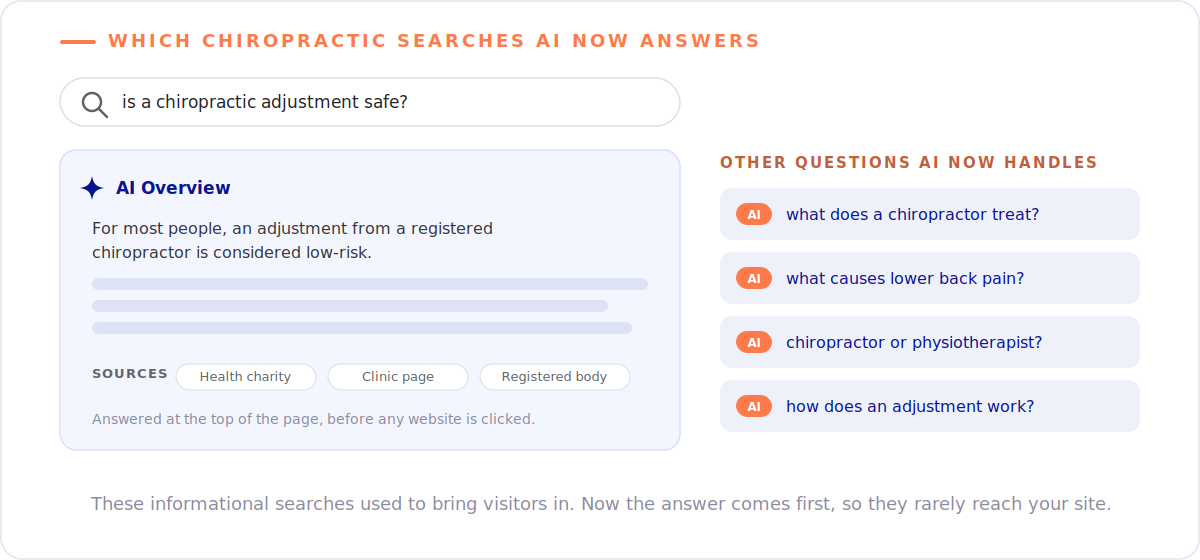
Most of the informational questions people used to search, such as what a chiropractor treats or whether an adjustment is safe, are now answered by an AI summary at the top of the page.
What still brings patients in are local, ready-to-book searches and the credibility signals that decide who Google and its AI answers show.
Chiropractic SEO Checklist
Tick each item your practice already has in place to see where the gaps are.
Why Chiropractic SEO Has Changed
Search used to send people to your site for an answer. Now it often gives them the answer first. For chiropractors, the questions that once drove traffic are exactly the ones AI now handles:
- Ranking for informational content is worth less.
Fewer people click through to websites with every search. The searches that still send patients to a chiropractor, the local, ready-to-book ones, are now worth more by comparison.
2. The priority is winning local searches and building credibility.
Rather than producing content to rank for every question, the winning strategy is to come first on Google Maps and rank for location-specific keywords (e.g. chiropractic west London). Chiropractic SEO is now all about building the credibility that makes Google, and its AI answers, confident enough to recommend you.
Local Visibility: Can Patients Find You at the Point of Need
Local SEO for chiropractors comes down to being found by someone ready to book nearby, and the biggest single lever is your Google Business Profile. A complete, accurate, active profile, with the right categories, hours, services, photos and regular posts, does more for local visibility than anything else.
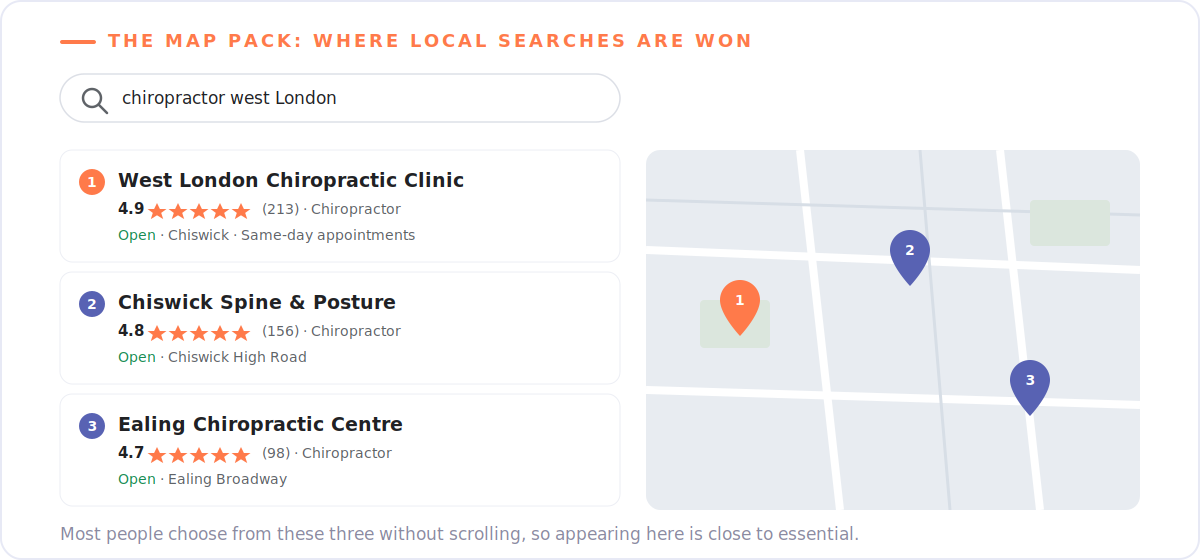
Above the standard results, Google shows a few local businesses on a map, the map pack. For a search like a chiropractor plus a town name, most people choose from that set without scrolling, so appearing there is close to essential.
Small mismatches, an old suite number or a former phone line, erode Google’s confidence in your data, and that same data is what AI answers pull from when they name a local business.

Trust: What Google and AI Answers Actually Cite
Chiropractic is a health topic, and Google holds healthcare marketing to a higher standard than most. It weighs experience, expertise, authority and trust most strictly for anything that can affect someone’s health or money. For a lot of practice owners, this is the first sign that they are working in a more scrutinised, more regulated corner of SEO than an ordinary local business faces, and that scrutiny decides who gets shown.
Here is roughly how the two compare:
| What Google weighs | Everyday topic (e.g. a recipe) | Health topic (your practice) |
| Who wrote it | Rarely matters | Named, qualified practitioners expected |
| Evidence for claims | Optional | Expected, and checked |
| Tolerance for mistakes | Forgiving | Low |
| Reviews and reputation | A bonus | Heavily weighted |
| Chance of being left out | Low | High if trust signals are missing |
Reviews are the clearest signal. How many, how recent, and whether you reply all feed both your ranking and a patient’s first impression. A steady stream of recent reviews beats a cluster from three years ago.
The people matter too. Name your chiropractors, show their GCC registration, set out their training, and give each a real profile. Google and its AI answers rely on this first-party detail, plus mentions of your practice on trusted local and health sites, to decide who to recommend.
Content That Still Earns Its Place
What earns its place is content close to the decision: clear pages for each service and condition you treat, written for someone deciding whether to book. These hold their value because they match searches with real intent. Write them in plain, factual, well-structured terms, since being quoted and credited in an AI answer is now its own form of visibility.
One caveat is specific to chiropractic SEO: only write about conditions you are actually allowed to claim to treat, which is the constraint most SEO advice ignores.
Claim Compliance: The Constraint Most Guides Ignore
Unsupported health claims are what Google’s health-content systems push down, and they also get chiropractic marketing in trouble with the regulator. So compliance and SEO pull the same way: publish only what you can back up, and you protect your rankings and your registration at once.
Chiropractors are regulated by statute through the General Chiropractic Council, and the Advertising Standards Authority, through the CAP Code, sets out in detail which conditions you may and may not refer to in your marketing. That list is updated as evidence is reviewed, so treat the ASA and CAP guidance, not a competitor’s website, as the source of truth for what you publish.
Your Website’s Technical Health: Fast and Mobile-Friendly
The technical side is not where you win, but it has to be right. Your site needs to work well on a phone, where most local searches happen, and load quickly, because slow pages lose both visitors and rankings. Beyond that, a well-built site simply helps Google find your website and understand what each page is about, so your pages actually show up.

One thing is easy to skip: without proper tracking, you are guessing. Set up analytics and tag management correctly, and you can see which searches and pages actually produce enquiries. If that is not in place, our GA4 and Google Tag Manager specialists can set it up once, properly.
Where to Start
Sustainable chiropractic SEO rests on four things: local visibility, trust for a health topic, useful and compliant content, and a sound technical base. None of it depends on chasing the informational rankings AI has absorbed. It depends on being the practice that a ready patient, and the AI answers serving them, can confidently choose.
You have just seen where your chiropractic SEO is weakest, and that is where new patients are slipping away. KD Web helps chiropractors turn a score like yours into a clear plan: stronger local visibility, trusted content that stays within the ASA rules, and tracking that proves what works.
Start by booking a free SEO review.